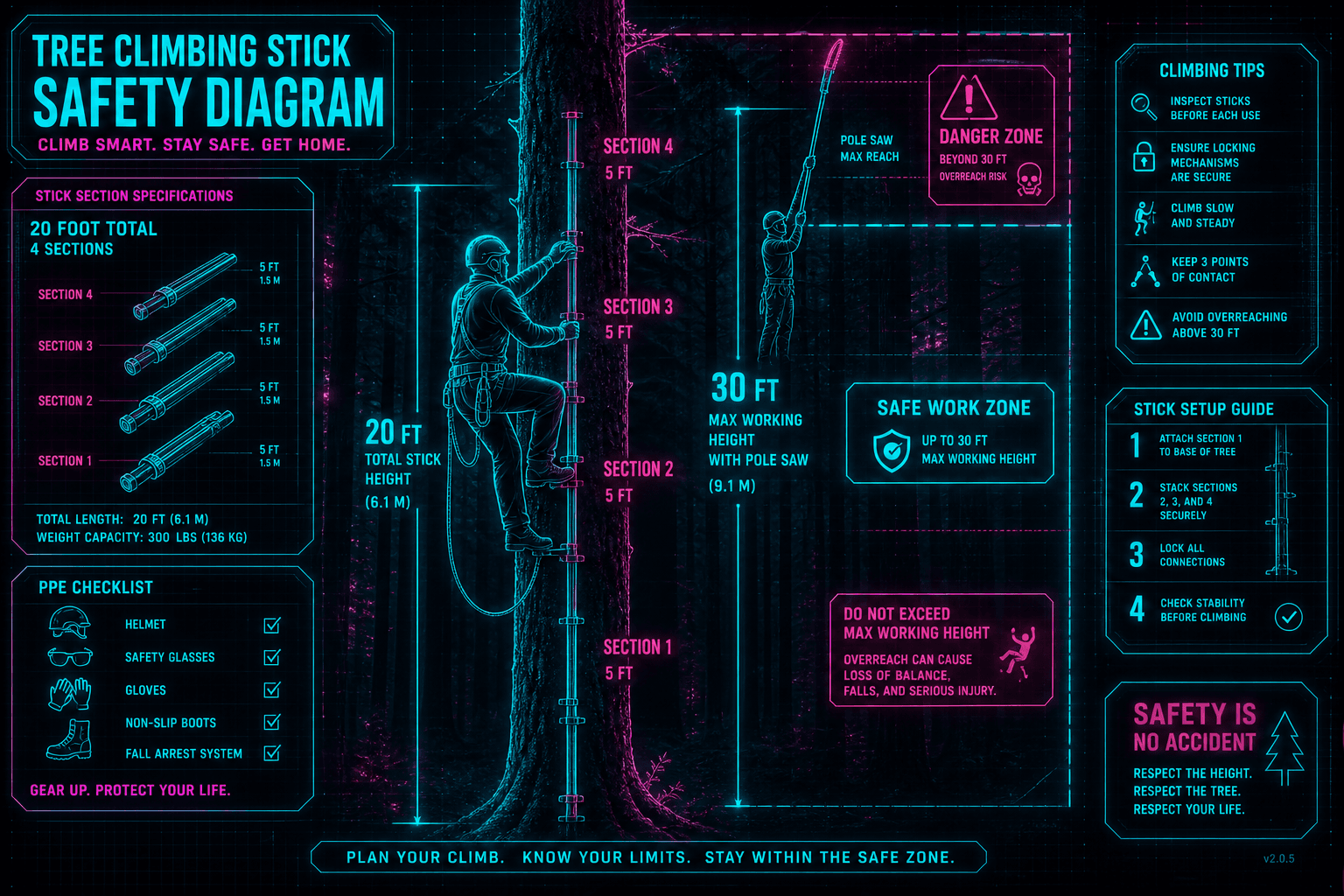
You want 30 feet of reach for canopy pruning and pole saw work at Wesley Woods. Tree climbing sticks — stackable sections you strap to the trunk — are one way up. They are not a shortcut around safety.
This article is the safety frame: when sticks help, when a cordless pole saw from the ground is still the right call, and why two 20-foot sections might get you close to 30 feet — but never all the way there in a straight stack.
The 30-foot goal
- Solar and canopy openings at height — see 23-foot pruning work
- Dead wood above pole saw reach from flat ground on slope
- Vine crowns tangled above maple scaffolding
Ground rule: extend the pole saw first. Add stick height only when the branch is truly out of pole range and an arborist is not required.
Two 20-foot sticks — the math
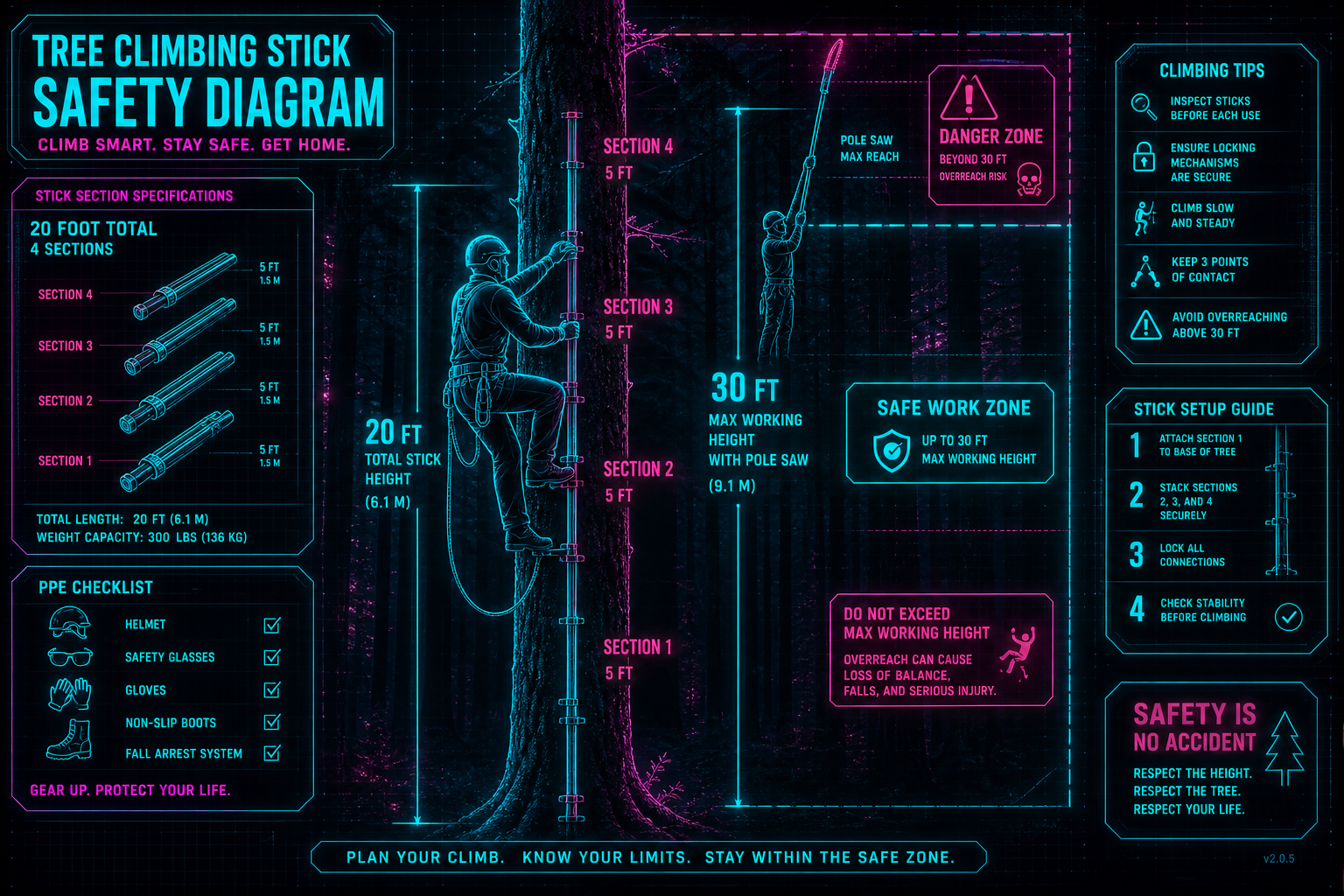
Commercial climbing sticks are often sold in ~20-foot section kits (multiple steps, not one 20-foot pole).
- Section 1 gets you to roughly 12–15 feet with safe step spacing
- Section 2 adds another band — total working height often lands near 25–28 feet, not a full 40
- 30 feet may be reachable with two sections plus your reach and tool length — but overlap, tree taper, and branch placement change the real number every tree
Do not assume 20 + 20 = 40 feet of safe work height. Assume plan for 30, verify on site.
Required safety stack
No exceptions on private stewardship land:
| Layer | Purpose |
|---|---|
| ANSI-rated climbing harness | Fall arrest anchor point |
| Climbing rope + prusik or mechanical ascender | Backup on trunk line |
| Lineman's belt or work-positioning lanyard | Hands-free at height |
| Helmet with chin strap | Head strike on slip |
| Eye and hearing protection | Same as ground pole saw |
| Non-slip boots | Wet bark is glass |
| Partner on ground | Communication and emergency |
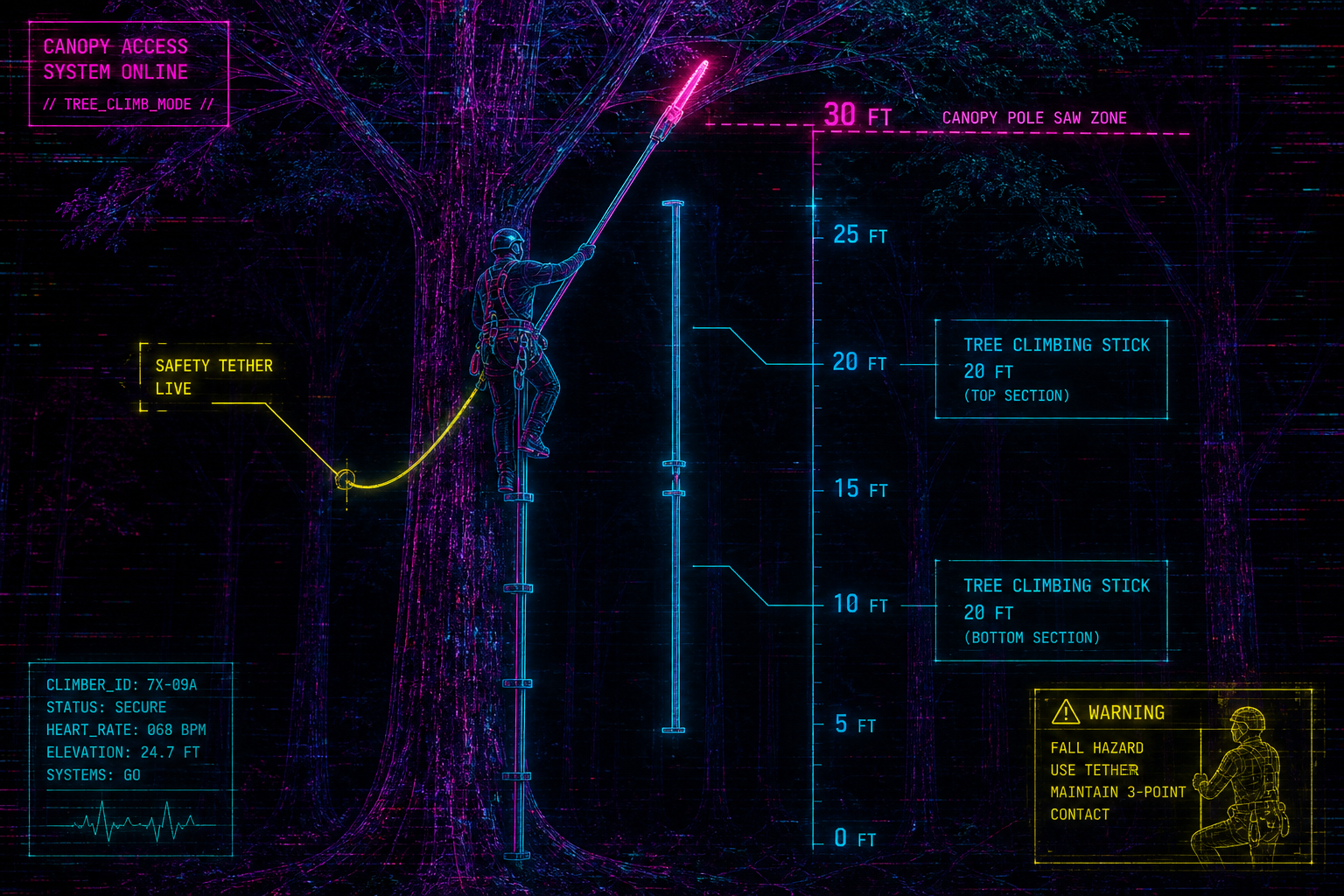
Tree climbing sticks alone are not a fall-protection system. You need a tethered climbing system independent of the steps.
Stick setup rules
- Pick the tree — healthy, straight bole, no dead top, no power lines in fall zone. Read partially fallen tree assessment first.
- Angle sticks slightly toward the trunk — manufacturer's spec, usually ~15°
- Strap each section per mfg torque; recheck after first weight load
- Never stand on the top step — maintain three points of contact
- Pole saw at height — lanyard the tool; one hand for you, not the trigger, when moving
- Descend before fatigue — most mistakes are last-cut mistakes
When sticks are the wrong tool
Stop and call an arborist when:
- The tree is leaning, split, or hung up
- You need 30 feet on a slope with bad fall zone behind you
- Branches are under tension against another tree
- You are alone without ground backup
- Local Tree Preservation Plan review requires licensed climber — Strongsville TPP
Pole saw + sticks workflow
Recommended sequence at Wesley Woods:
- Ground pole saw to max safe extension — often 12–18 ft effective
- Climbing sticks only for remaining band toward ~30 ft
- Small cuts — drop zones cleared on the trail slope
- Document cuts for permit files — 360° site capture
Two 20-foot stick kits may bridge the gap to 30-foot pole saw work. They do not replace training, harness, rope, or the stop rules. Feet on ground when you can. Sticks when the numbers and the partner check out.