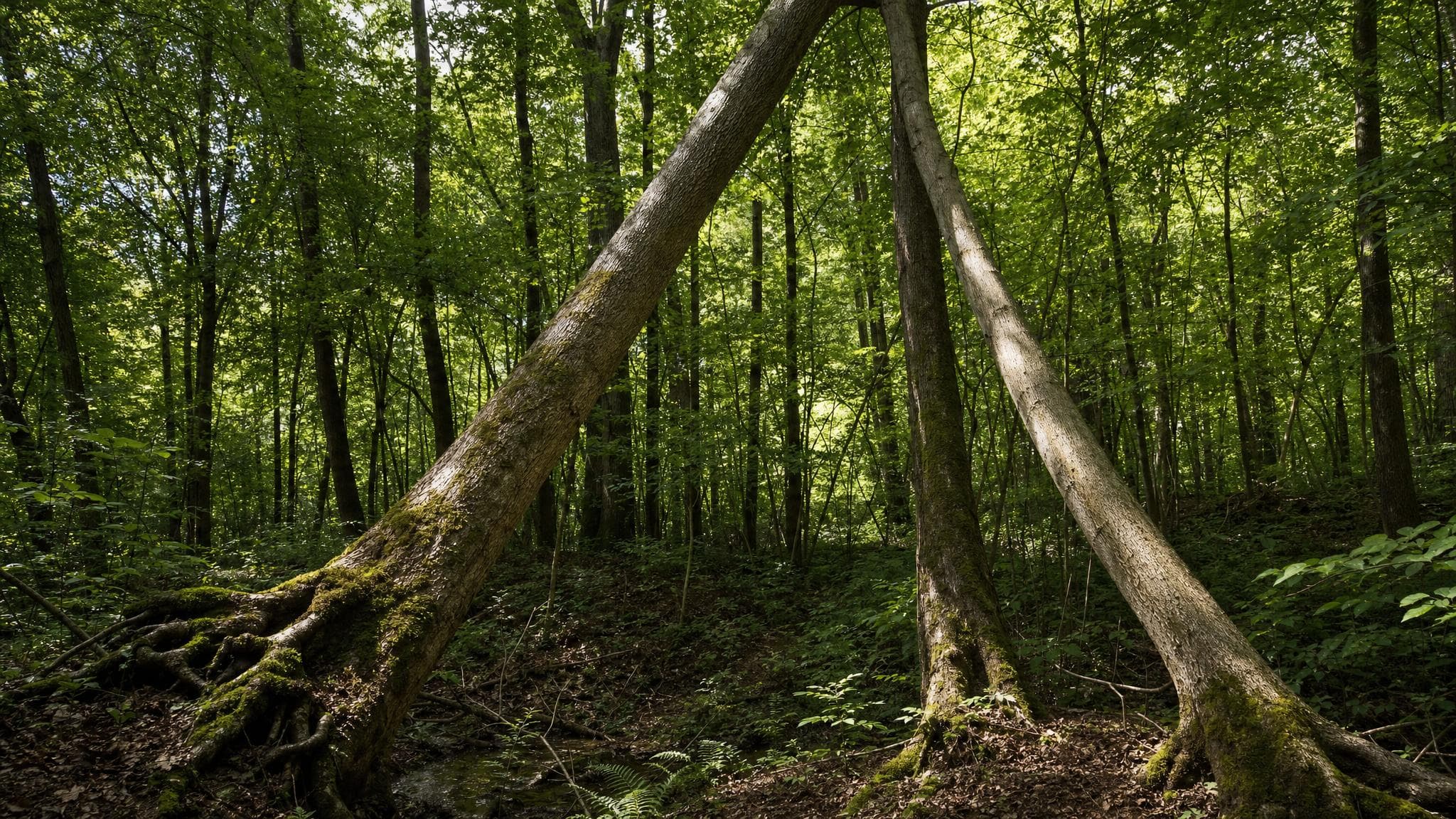
Not every fallen tree falls all the way. Two of them at the Wesley Stump Family Foundation's Strongsville property are proof of that — partially down, their root plates lifted and trunks canted at an angle, but caught and held by neighboring trees rather than the ground. They've been that way long enough to become part of the landscape.
Rather than assume the worst and call for removal, the Foundation requested an assessment from a Strongsville city arborist — an on-site evaluation to determine whether the trees posed any real danger or whether they could safely remain.
The arborist's conclusion: both trees are safe to leave in place for at least a year.
What the Arborist Evaluated
The city arborist's site visit covered three primary factors, each one part of a systematic approach that any professional tree evaluation should include.
The trees themselves. The arborist examined the structural condition of each leaning tree — looking at the trunk, the root plate, and the canopy for signs of decay, split wood, or active failure. A partially fallen tree that is actively rotting or splitting is a different risk profile than one that is simply leaning and stable. In this case, both trees showed no signs of accelerating deterioration.
Clearance and fall zone. The most critical question with any leaning tree is: if it falls completely, where does it land, and what does it hit? The arborist mapped out the fall zone for each tree and confirmed that the area below and beyond the trees is clear of structures, outbuildings, fencing, and other hazards. A tree that falls entirely within natural woodland — landing on soil and existing forest floor — poses no structural risk.
Prevailing wind direction. Wind is the most common trigger for a fully downed tree completing its fall. The arborist considered the prevailing wind pattern for the site, which comes predominantly from the north-northwest. Given the orientation of both leaning trees relative to that wind vector, even in a significant storm event, the direction of potential fall remains within the established safe zone. The trees are not oriented in a way that wind loading would push them toward any structure or path.
The One-Year Window
The arborist's clearance is not indefinite — it's a one-year window based on current conditions. That timeline matters for a reason. Partially fallen trees can be stable for years, or they can deteriorate faster than expected depending on what's happening below the soil surface at the root plate. Checking back annually, or after any significant storm, is the right approach.
If there's any change in the lean — visible progression, cracking sounds, fresh root exposure, or new soil heave — that's the signal to reassess immediately.
What to Do When a Tree Falls on Your Property
The Foundation's experience here is a useful template for any private property owner dealing with a downed or leaning tree.
Don't assume it needs to come down immediately. A partially fallen tree is not automatically an emergency. Panic-driven removal can be expensive and unnecessary. The first step is observation — how stable is it, what is it leaning against, and what is in the fall zone?
Contact a professional for assessment. In many municipalities, including Strongsville, the city arborist is a free public resource for tree-related concerns on private property. A trained arborist will assess species, structural integrity, fall zone, and site conditions in a way that a non-specialist simply cannot.
Map the fall zone yourself. Before any professional arrives, walk the area. Identify structures, pathways, utility lines, and neighbor property lines within a radius roughly equal to the tree's height. Photograph the lean and root plate. This documentation helps the arborist and gives you a baseline for future comparison.
Understand the difference between hazard and nuisance. A leaning tree in a clear woodland area is often a nuisance aesthetically but not a genuine hazard. A leaning tree over a driveway, roof, or play area is a different situation entirely. The professional evaluation should address which category you're dealing with.
When removal is necessary, hire certified help. If an arborist recommends removal, do not attempt it yourself with a chainsaw on a leaning tree under tension. A tree under stored mechanical load can split, kick, or roll in unpredictable directions when cut. This is exactly the scenario where professional equipment and technique are non-negotiable.
Leaving the Trees in Place
For now, both partially fallen trees at Wesley Woods will remain where they are — held by their neighbors, safe within their fall zone, and given the time to continue what they started. In a forest, a fallen tree is rarely waste. As it settles and begins to break down, it becomes nurse log material, habitat for insects and small mammals, and eventually, soil.
The city arborist didn't just clear the trees. They gave the Foundation permission to let nature work.