There is a branch on almost every wooded property that needs to come down — dead wood hanging over a trail, a sucker shoot crowding a Sugar Maple trunk, a limb too low over the driveway. The mistake most people make is reaching for a ladder. The better move is to keep your feet on the ground and bring the saw to the branch.
That is what a cordless pole saw is for. These instructions are what the Wesley Stump Family Foundation publishes online for that work: a simple tool, used the right way, with the gear that keeps you from learning the hard way.
This is not a scheduled class or an in-person event. It is a field guide you can read before you cut — the same checklist stewards use at Wesley Woods, posted here so anyone maintaining private woodland can follow it on their own land.
What You Are Actually Doing
A cordless pole saw is not a chainsaw on a stick you wave around until something falls. It is a controlled reach tool. The motor and battery sit at the handle end. A telescoping pole extends the bar and chain to branches you cannot touch with a hand saw. You cut from below, at an angle, with both hands on the tool and both feet planted.
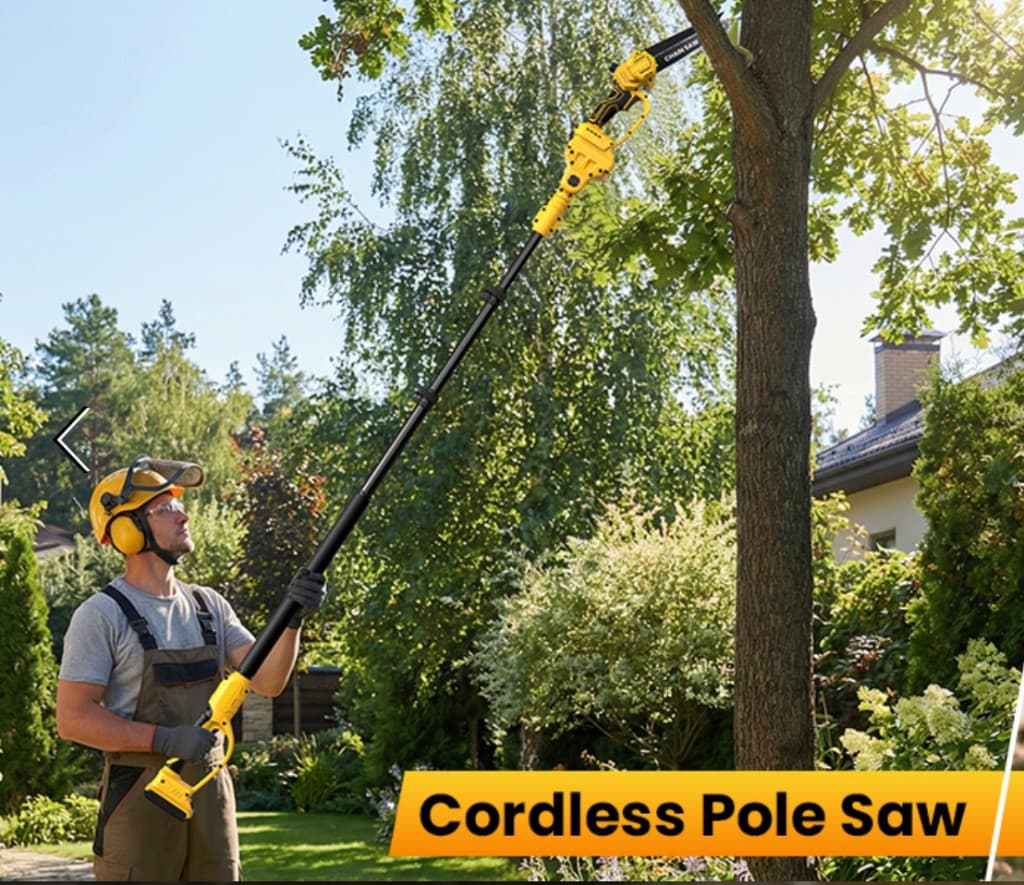
The photo tells the story: hard hat, face shield, hearing protection, safety glasses, work gloves. That is not costume. That is the minimum for any overhead cutting session, even a short one on a quiet afternoon in your own yard.
The Gear That Matters
Hard hat with face shield. Overhead work means overhead failure. A cut branch does not always fall where you expect. The shield catches chips and small debris; the hat takes the hit if something heavier comes down wrong.
Hearing protection. Pole saws are quieter than full chainsaws, but they are not quiet. Twenty minutes of cutting without earmuffs is twenty minutes of damage you do not feel until later.
Eye protection. Even with a face shield, keep safety glasses on. Sawdust finds gaps.
Gloves with grip. You need control of a tool that is vibrating, extended, and top-heavy. Smooth hands on a slick handle is how poles twist mid-cut.
Stable footwear. No sandals. No worn-smooth sneakers. Boots with tread, on level ground, before you extend the pole.
Before You Pull the Trigger
Walk the job first. That sounds obvious and almost nobody does it thoroughly enough.
Look up: what is above the branch you are cutting? More branches? Power lines? Another tree that the cut piece could hang on?
Look down: where will the branch land? Trail, roof line, neighbor's fence, your own foot?
Look at the branch itself: is it dead and brittle, or live and under tension? A branch pinned under another limb behaves differently than one hanging free. Tension cuts kick. Dead wood drops fast.
If any of that makes you hesitate — stop. These instructions are honest about limits. A pole saw handles maintenance pruning. It does not replace an arborist for trees under load, partially fallen trunks, or anything where the fall zone is unclear.
The Cut Sequence
-
Extend the pole only as far as needed. Longer pole means less control. Start short, add length if you have to.
-
Position yourself offset from the fall line, not directly under the branch.
-
Support the tool with both hands. Never one-hand a running pole saw to reach an extra six inches.
-
Cut from underneath when possible, through the branch in a smooth stroke. Let the tool do the work. Do not force the bar.
-
Step back before the piece releases. Give it room to fall.
-
Clear the ground before the next cut. A trip hazard at your feet while the pole is extended overhead is a real problem.
-
Battery and bar check between cuts. Cordless means you can run out of power mid-job. A loose bar is worse.
When These Instructions Say Stop
The Foundation publishes this clearly because the wrong cut on the wrong tree is not a learning moment — it is an emergency.
Call a professional instead when:
- The tree is partially fallen or leaning under tension
- The branch is over a structure, path, or property line you cannot clear
- You need a ladder to reach the work (the pole saw should eliminate the ladder, not replace good judgment with extra reach)
- The wood is large enough that a pole saw is the wrong tool — anything that needs a full chainsaw and wedge work belongs to someone certified
- You are not sure what will happen when the branch comes free
The partially fallen tree assessment at Wesley Woods is the other half of this story: sometimes the right safety move is leave the tree alone and let an arborist tell you it can stay.
Why This Fits Private Woodland Stewardship
Wesley Woods is private, closed to the public, and actively maintained. That means deadwood gets addressed, trail clearance happens on schedule, and Sugar Maples get air around their trunks without someone climbing into the canopy with a handsaw and hope.
A cordless pole saw — solar-charged at the trail edge, used in short sessions with full PPE — is how you keep that work safe and repeatable. No extension ladder leaned against a maple. No one standing on a wet slope reaching overhead. Feet down, saw up, branch on the ground, walk away clean.
Checklist Before You Start
Use this as a printed or on-phone checklist when you head out:
- Tool inspection: battery, chain tension, oil, pole locks
- PPE on: hat, shield, ears, eyes, gloves, boots
- Site walk: fall zone, overhead hazards, footing
- Start on low deadwood if you are new to the tool — not live canopy work on day one
- Read the branch: tension vs. compression before every cut
- Know your stop conditions and when to call an arborist
- Cleanup: chip or haul, never leave cut wood across a trail overnight
"Most people who get hurt trimming trees get hurt because they skipped the walk-through and the hard hat," said a Foundation steward. "The saw is the easy part. The discipline is reading the instructions and actually following them."
If you steward wooded land — especially private land with historic trees worth protecting — published safety instructions are not bureaucracy. They are how you keep the maples standing and keep yourself standing too.