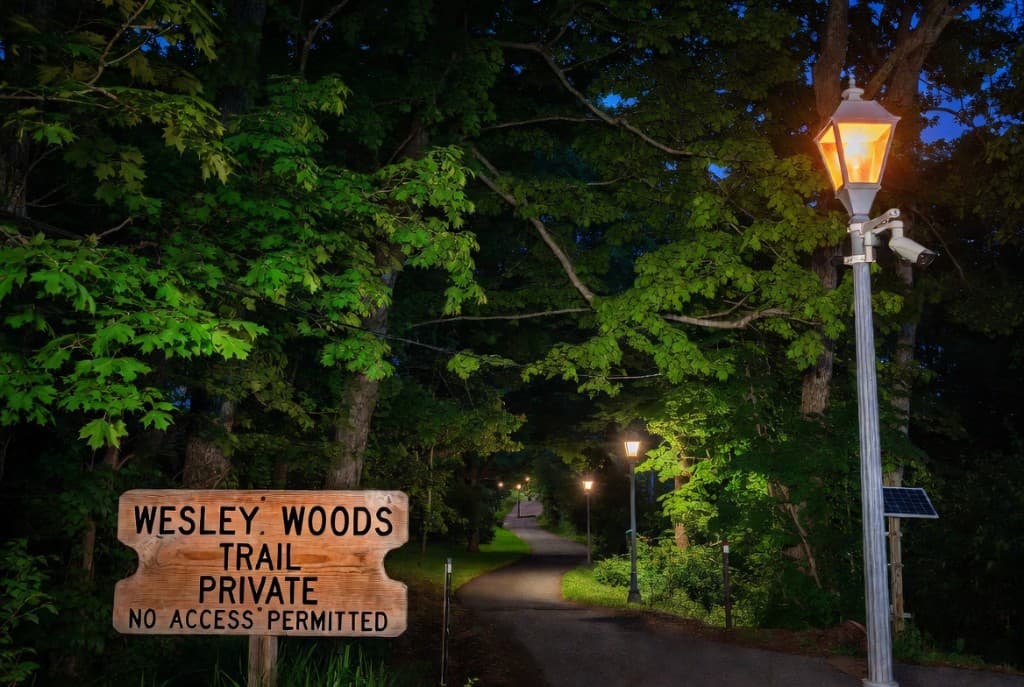
Most security systems feel like they were built for a parking lot. Bright white floods. Hard angles. The message is always the same: you are being watched.
Wesley Woods needs something different.
The historic Sugar Maples at the center of this property are the whole reason the land matters. Any system that protects them has to live under the canopy — not blast light from the street, not fight the forest, not make a private woodland feel like a warehouse at night. It has to feel like the woods, only clearer.
That is the canopy security node: a small cluster of posts and equipment beneath the maple canopy at the trail head — warm glow lighting, soft ambient sound, a voice channel for calm notices, and an LCD sign post that tells you what you need to know before you take another step.
What It Feels Like at Dusk
Picture arriving at the edge of the property when the day is almost gone. The overhead maples are still dark green against a sky that has not fully turned. Under the canopy, the light is different — amber, low, spread wide instead of punched down in a circle. You can see the path. You can see the sign. You can hear a faint sound: not music exactly, more like the woods with the volume turned up just enough to know you are somewhere cared for.
The LCD post reads something simple:
Wesley Woods Trail — Private — No Access Permitted
Maybe below that: trail closed, stewardship in progress, or a line from the Learn program about Ohio valley history — a sentence about canals, maples, or the land before the roads. The sign updates. The wooden trail sign stays. The LCD handles what changes day to day.
A voice channel — recorded, calm, not aggressive — can repeat the private notice for someone approaching in the dark, or welcome an invited steward by name. Same system, two modes. Public edge gets clarity. Invited access gets courtesy.
That is the lifestyle this system serves. Not surveillance theater. Orientation in the dark.
The Four Pieces
Warm glow lighting. Low LED fixtures aimed down and out under the canopy, color temperature warm (2700K–3000K range), shielded so light stays on path and sign — not in drivers' eyes, not up into the canopy where it would confuse roosting birds. Enough to walk safely. Not enough to feel like a stadium.
Ambient sound. Optional low-level audio: wind-through-maple loops, seasonal creek sound from the wetland below, or silence. The speaker is not for announcements blasting over the neighborhood. It is for texture — the sense that this place is alive and tended.
Voice channel. A separate line in the system for short voice messages: private notice, weather hold, invited access greeting, or a Learn snippet read aloud for stewards doing an evening check. Pre-recorded, timed, volume-capped. Never shouting.
LCD sign post. A weatherproof display at eye height on the same post cluster as the lamps. Status, rules, date, optional QR to public educational content (not a map into private land). The wooden Wesley Woods Trail — Private sign remains the permanent anchor; the LCD is the living layer.
Why Under the Canopy
Edge lighting alone — lamp posts at the street line — solves part of the problem. It marks the boundary. It supports cameras facing the property. Permit #26001680 covers that layer.
The canopy node solves the other part: what it feels like inside the threshold, where the historic trees are. Sugar Maples regulate temperature, hold moisture, and create the microclimate everything else depends on. A security system that ignores the canopy ignores the asset it is supposed to protect.
The solar post research already established the rule: minimal canopy opening, only where a natural gap exists, no casual thinning. The node uses one or two small solar posts with panels catching light through that opening, 12V battery storage at the base, and low-voltage runs to the fixtures under the branches. No trenching through root zones. No concrete footings if a driven post will do.
Security Without Hostility
Cameras stay part of the cluster — property-facing, not street-facing. They record the access edge and the trail head, not the neighbors' lawns. Combined with warm light and a clear sign, they deter trespass before it becomes foot traffic on root zones.
The goal is boring and good: keep unauthorized people out, keep invited stewards safe, keep the historic trees from becoming a shortcut or a dump site, and leave the woods quiet for everything that belongs there — owls, deer, the yellow lilies downstream, the next wave of maple saplings filling shade gaps over time.
How It Connects to What Exists
This is not a third isolated project. It is the center that ties other work together:
- The private historic-tree trail — the path the node guards
- The electrical permit — power and code compliance for posts, solar, and low-voltage runs
- The pole saw safety instructions — how stewards maintain branches around the canopy without ladders
- The partially fallen trees assessment — when not to cut, when to call an arborist instead
- Spelunking Safety and the /safety program — slope, footing, and trail carpentry for the same land
Each piece stands alone. Together they describe a private woodland that is maintained, lit, signed, trained, and closed — on purpose.
What Comes Next
The node is in design, not installation. Before anything is mounted under the maples:
- Finalize fixture placement with a walk-through at dusk (where does warm light actually land?)
- Confirm solar post locations against canopy opening survey
- Write the LCD message set: default private notice, stewardship mode, Learn rotation
- Record voice prompts — calm, short, repeatable
- Coordinate with Strongsville on any right-of-way overlap at the tree lawn edge
- Document the build for the Learn archive
"A good secure system does not feel secure," said a Foundation representative. "It feels clear. You know where you are. You know you are not supposed to go forward unless you were invited. You can see the maples above you and the path below you and the sign that tells the truth. That is enough."
Private land. Warm light under old trees. A sign that speaks. The woods stay the woods.