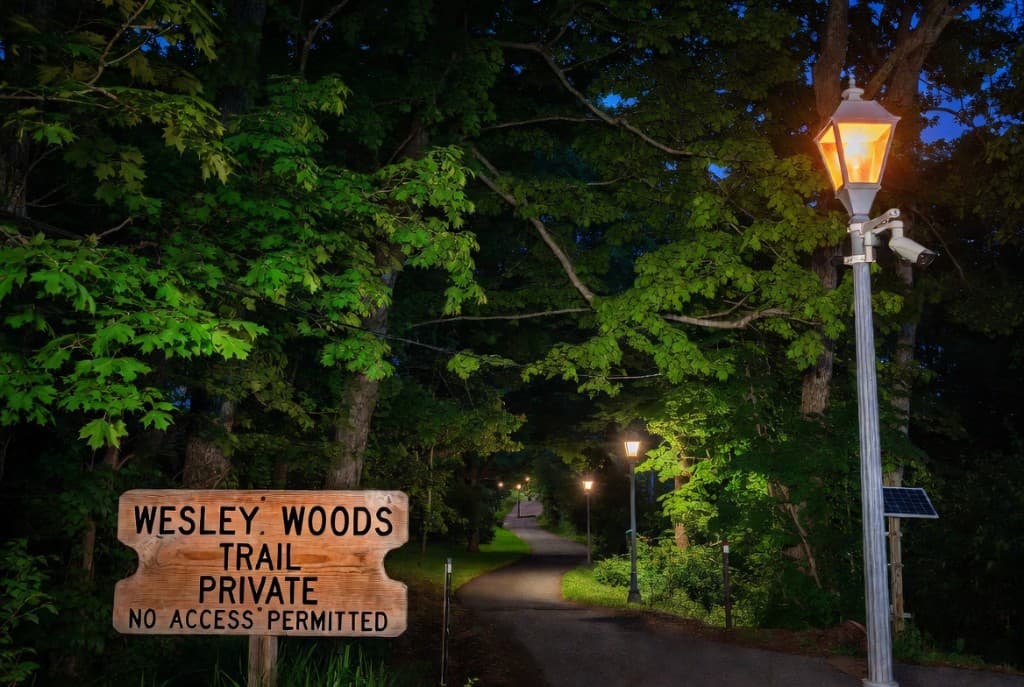
Some trees were here before the roads were. Before the subdivision, before the survey stakes, before anyone thought to put a name on this stretch of Strongsville ground. The Wesley Stump Family Foundation is building a walking trail to honor them — a quiet path that moves from one historic tree to the next, lit softly at dusk, and kept entirely private.
The sign at the trailhead says it plainly: Wesley Woods Trail. Private. No Access Permitted. That is not unfriendly. It is the whole point. This is a stewarded private woodland, not a public park — and the trail is being built to protect the trees, not to draw a crowd.
A Path Built Around the Trees
Most trails are routed for convenience. This one is routed for reverence. The path bends to pass the property's most significant specimens — mature Sugar Maples with trunks too wide to wrap your arms around, old hardwoods that have held this slope together for generations, and a handful of trees the Foundation considers historic markers of what this land was before it was anything else.
The route is deliberately narrow and low-impact. It follows the natural contour, keeps clear of major root zones, and uses materials harvested on-site wherever possible — the same approach the Foundation has taken with every trail and structure at Wesley Woods. The goal is a path that feels like it was always there.
Along the way, simple interpretive points will mark each historic tree: its species, its rough age, and what it tells us about the original forest. This is content for the Foundation's own record and its Learn program — documented privately, shared as educational material, but never as an invitation to walk the land.
Lit, Watched, and Closed
The trail is designed to be used at dusk and into the evening, which is why lamp posts line the path — warm, low lanterns on simple posts that give just enough light to walk safely without washing out the dark or disturbing wildlife more than necessary. Each post is paired with security cameras. The lighting is for the people who steward the land; the cameras are for the land itself.
This is private property under active management. The lighting and monitoring exist to protect the historic trees from trespass, vandalism, and the kind of casual foot traffic that compacts soil and damages roots over time. No public access is permitted. The trail serves the Foundation's stewards, documented research, and invited participants only.
Why a Permit and a Utility Connection Are Required
A lit trail is not just a path — it is infrastructure, and it has to be built like infrastructure.
Building permit. Installing fixed lamp posts, running conduit, and setting permanent footings along the trail triggers a building and electrical permit with the City of Strongsville. The Foundation intends to file for the appropriate permit before any posts are set, the same way it has approached the canal channel and bicycle bridge projects — working with Strongsville Building & Housing rather than around them. The permit will cover the post footings, conduit runs, fixture ratings, and the electrical work that ties it all together.
Electric utility connection. The lamp posts and cameras need power. That means a metered electric utility connection to the property and a code-compliant circuit run out to the trail — buried conduit, weatherproof fixtures, GFCI protection, and a panel sized for the load. Some posts may also carry small solar panels to supplement the grid connection and keep the lighting running during outages, consistent with the Foundation's interest in low-impact, partly off-grid power. Either way, the connection has to be inspected and approved before the lights come on.
Neither step is optional, and neither is being skipped. A historic-tree trail that ignored permits and utility code would be exactly the wrong way to honor the trees. Do it right, do it with the city's sign-off, and build something that lasts.
What Comes Next
The trail route has been walked and the historic trees identified. Before construction:
- File the building and electrical permit with the City of Strongsville
- Establish the electric utility connection and have the circuit design reviewed
- Set lamp post footings and run conduit along the approved route, clear of major root zones
- Install lighting, cameras, and interpretive markers at each historic tree
- Document each tree for the Foundation's Learn archive
Work will not begin until the permit is approved and the utility connection is inspected. The Foundation will document the build through the 2026 season.
"These trees outlived everyone who came before us, and they'll outlive us too," said a Foundation representative. "The trail isn't for foot traffic. It's a way to walk slowly past something older than the town and remember to take care of it. Private, lit, watched — because that's what protecting them actually takes."
The sign stays up. The path stays closed to the public. And the giants keep standing, a little better cared for than before.