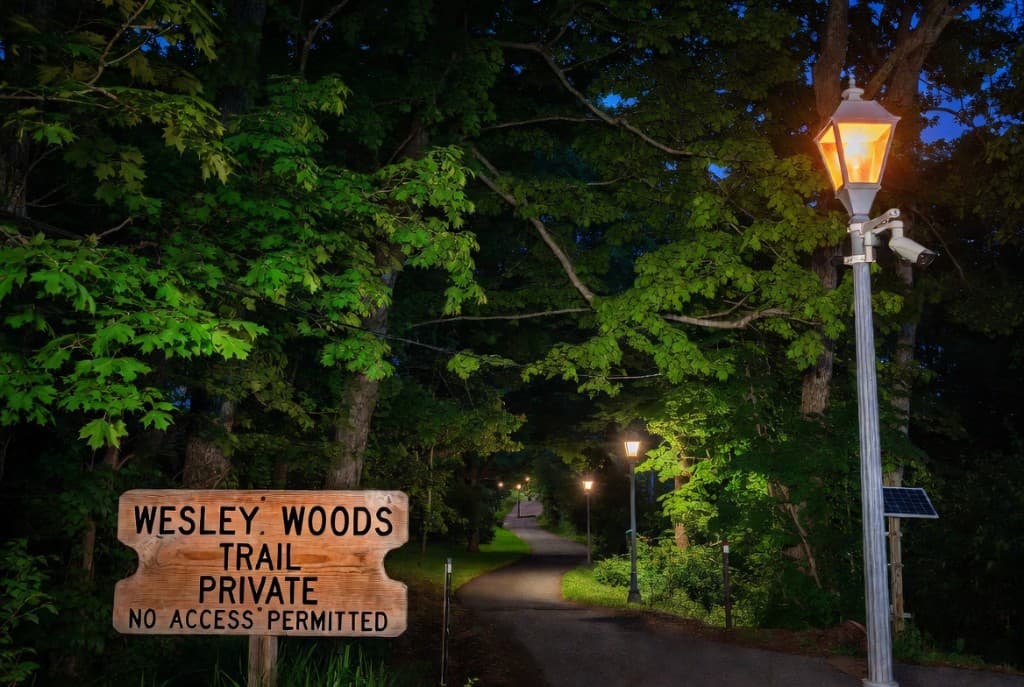
There is a particular hour at Wesley Woods when the trail stops feeling like a project and starts feeling like a place.
It is not quite dark. The canopy above is still green-black against a sky that hasn't fully let go of the day. The lamp posts come on one by one — warm, low, not harsh — and the path below them turns from something you navigate to something you inhabit. You can hear the woods settle. You can see the sign at the head of the trail: Wesley Woods Trail. Private. No Access Permitted. And you understand, standing there, that the light isn't for show. It's for stewardship.
On June 14, 2026, the Wesley Stump Family Foundation filed Building Permit #26001680 with the City of Strongsville — the formal step that lets this private evening landscape exist the right way.
The Life of a Closed Trail
Wesley Woods is not open to the public, and that is intentional. The historic Sugar Maples and old hardwoods along this path were here before the roads, before the subdivision, before anyone put a name on this ground. A public trail would mean foot traffic, compaction, trespass, and the slow wear that kills root zones without anyone meaning to do harm.
So the trail stays closed. The sign stays up. And the people who steward the land get something rare: a private walk among trees that outlive the town, at the hour when the woods are most themselves.
That is the lifestyle this project serves. Not a park. Not an attraction. A quiet, repeated ritual — walk the line, check the trees, stand at the edge where the lilies and the slope meet the street tree lawn, and go home knowing the land was left better than you found it.
What the Light Actually Does
Picture the path from the photo: lamp posts with soft lanterns, a small solar panel on each post, a camera mounted quietly below the light. The wiring runs low-voltage — roughly 20 volts, not a heavy grid pull — up the front slope and along the tree lawn where the elevation rises toward the upper lot.
Solar-first means the posts can keep doing their job even when the grid hiccups. Low-voltage means less trenching, less conduit, less root disturbance in a place where every root matters. The Foundation has been clear with the city that no trees need to come out for this to work — the plan is minimum clearance, minimum footprint, maximum respect for what's already standing.
At dusk, the effect is simple. You walk. The path is visible. The historic trees are visible. The boundary between private land and the public tree lawn is visible. You are not stumbling in the dark, and you are not flooding the woods with stadium light. It is the right amount — enough to move safely, enough to see what you came to see, not enough to chase the night creatures away.
Why the Paperwork Matters to the Experience
None of this works as a lifestyle if it's built sloppy. A lit private trail that ignored code, right-of-way rules, or the Engineering Department's say on the tree lawn would eventually create the exact problems the trail is meant to prevent — conflict with the city, rework, torn-up ground, stressed roots.
Permit #26001680 is the Foundation saying: we want this feeling to last. We will coordinate with Strongsville Building & Housing. We will get Engineering approval before touching the public tree lawn. We will survey the property line. We will meet inspectors on-site and route the wiring where it does the least harm.
That is not bureaucracy for its own sake. It is how you protect a private evening walk among giants — by building the infrastructure once, correctly, and then leaving the woods alone.
A Camera Is Not a Weapon
The cameras on these posts are not pointed at the neighborhood. They face the property — the access points, the trail edge, the places where trespass and dumping actually happen on vacant wooded lots like this one.
The goal is boring and good: keep the historic trees standing, keep unauthorized foot traffic off the root zones, and give stewards a clear record of what happened at the boundary on any given night. The system protects the land so the land can keep doing what it does — holding water, feeding the wetland below, throwing shade for the next wave of maple saplings.
What This Adds to the Story
The trail article described the vision — a path built around the trees, lit at dusk, closed to the public. This piece is the follow-through: the permit that makes the glow legal, the solar that makes it durable, the low-voltage routing that makes it compatible with roots and canopy.
When the work is done, the experience stays the same as the photo suggests. You arrive at the head of the path. The sign is legible. The lamps are on. The woods are quiet. You are not invited in unless you were invited in — and for the people who were, the walk is something worth showing up for.
"We asked for the permit before we touched a tree," said a Foundation representative. "That's the whole approach. Protect what's old. Follow the code. Work with the city. Then walk the trail at dusk and remember why any of this mattered."
The sign stays up. The trail stays closed. The lights come on anyway — for the land, not the crowd.