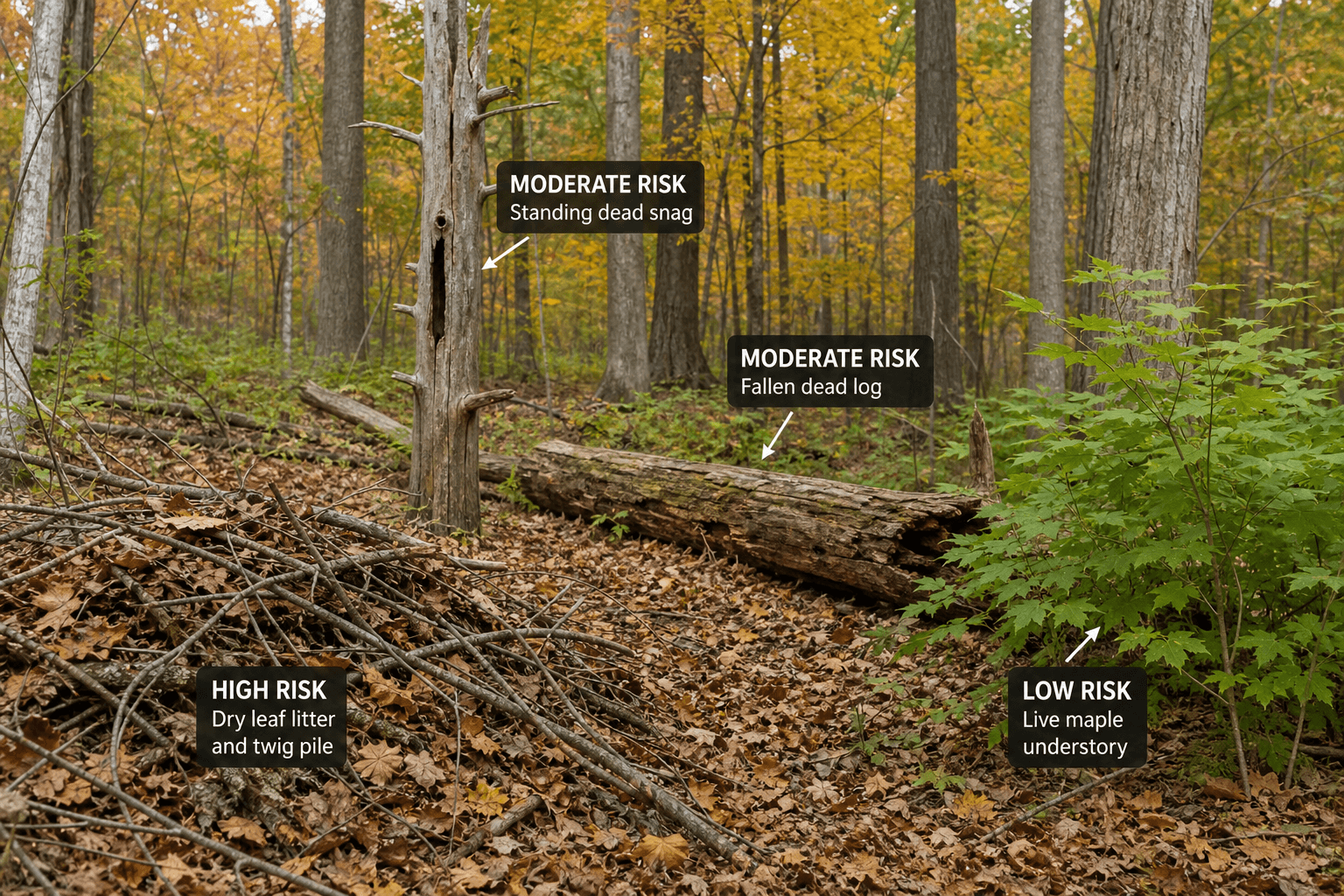
Before you build a survival fire, you clear the ring. But what counts as combustible brush — and what is dead wood that is not the same threat?
Fire risk is not yes/no. It is a spectrum of size, moisture, air, and location.
High risk — clear this first
These carry fire fast. Clear 3 feet minimum around a fire ring; 15 feet is better if you are staying awhile.
| Fuel | Why it burns fast |
|---|---|
| Fine twigs (pencil-thin and smaller) | Huge surface area, dries in days |
| Leaf litter mats — especially maple | Pack flat, hold heat, float embers |
| Dry grass and sedges at edge | Flash fuel in wind |
| Bark shreds and vine tangles | Airy, resinous, catches from sparks |
| Brush piles you raked into heaps | Chimney effect — piles burn hotter than scattered duff |
If you would use it as kindling, it is a clearance problem when it sits near flame.
What to do: Rake away, scatter, or haul to a compost/brush zone off the trail — same ethic as leaf work on rooty sites. Do not leave a dry heap uphill of your ring.
Medium risk — manage, do not ignore
| Fuel | Notes |
|---|---|
| Thumb-thick dead branches on ground | Burn in the fire as fuel once ring is safe — not as surrounding hazard |
| Standing dead snags under 6 inches | Can throw embers if fire is too close; keep flame outside fall zone |
| Partially attached dead limbs | Fall when heated — cut or avoid siting fire beneath |
| Small dead saplings | Pull or cut if within clearance circle |
Check overhead: a survival fire should not sit under dead hangers or bark-heavy birch/paper debris.
Lower risk — often leave alone
These are not the same threat as a dry brush pile — but location still matters.
| Material | Why it is lower risk |
|---|---|
| Large rotted log — crumbles in hand | High moisture, low surface-to-volume; smolders more than flashes |
| Moss-covered downed wood | Wet outer layer; do not assume interior is dry — test by weight and sound |
| Solid sound log (not punky) | Slow to ignite from embers alone; still move if between fire and treeline |
| Live green brush | Not good fire fuel — but can dry after a fire and become next year's hazard |
| Fresh stumps | Usually moist; watch resinous pine/oak stump hearts in summer |
Signs a log is not a brush-pile threat:
- Heavy, sits low in mud or leaf mold
- Punky — screwdriver sinks in
- Fungi — turkey tail, shelf mushrooms (decay = moisture)
- Damp smell, cool to touch in shade
- No crackle when you knock two pieces — dull thud
Signs it still needs distance from flame:
- Hollow — embers can tunnel inside
- Hanging over the ring
- Bridge between fire and fine fuels uphill
Dead trees vs. brush piles
A brush pile is engineered accident: fine material, air gaps, vertical heat. A single dead tree on the ground is mass — slow to start, hard to fully consume, often better left for habitat or contour work.
Clear for fire prep: fine surface fuels, piles, vines, litter within your circle.
Process naturally elsewhere: big rotting logs off the trail, snags that are stable and away from paths, wood you will season for firewood in a proper stack.
Survival fire checklist — brush edition
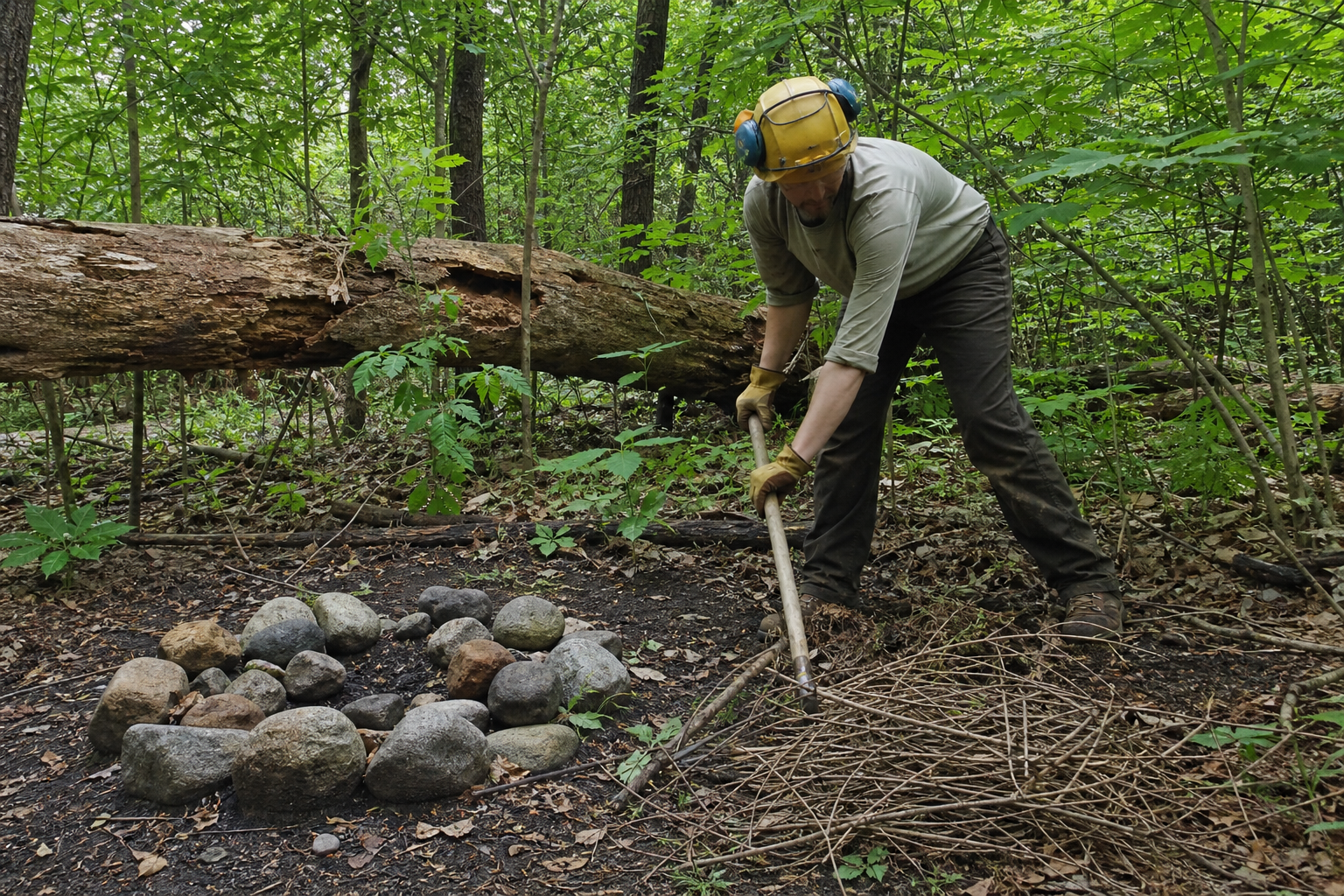
- Scrape mineral soil or stone ring — bare dirt, not leaf mat
- Clear fine fuels 3–15 ft out — twigs, leaves, grass, piles
- Look up — no dead branches overhanging
- Look downhill — fire travels uphill; clear the upslope side extra
- Stage water and shovel before kindling
- Burn small — seasoned splits, not green logs and not a brush pile dump
- Cold out — stir ash to mineral soil
Processing without burning on site
You do not have to torch brush to manage it:
- On-site compost with green material for hot piles
- Chip if volume warrants
- Contour lay small logs on grade for erosion — not heaped as a bonfire stack
- Season straight pieces for firewood; leave punky habitat logs
Combustible brush is anything fine, dry, and close. The job is tell it apart from dead wood that is slow, wet, or habitat — clear the first, place the second, and build your survival fire in the gap between.