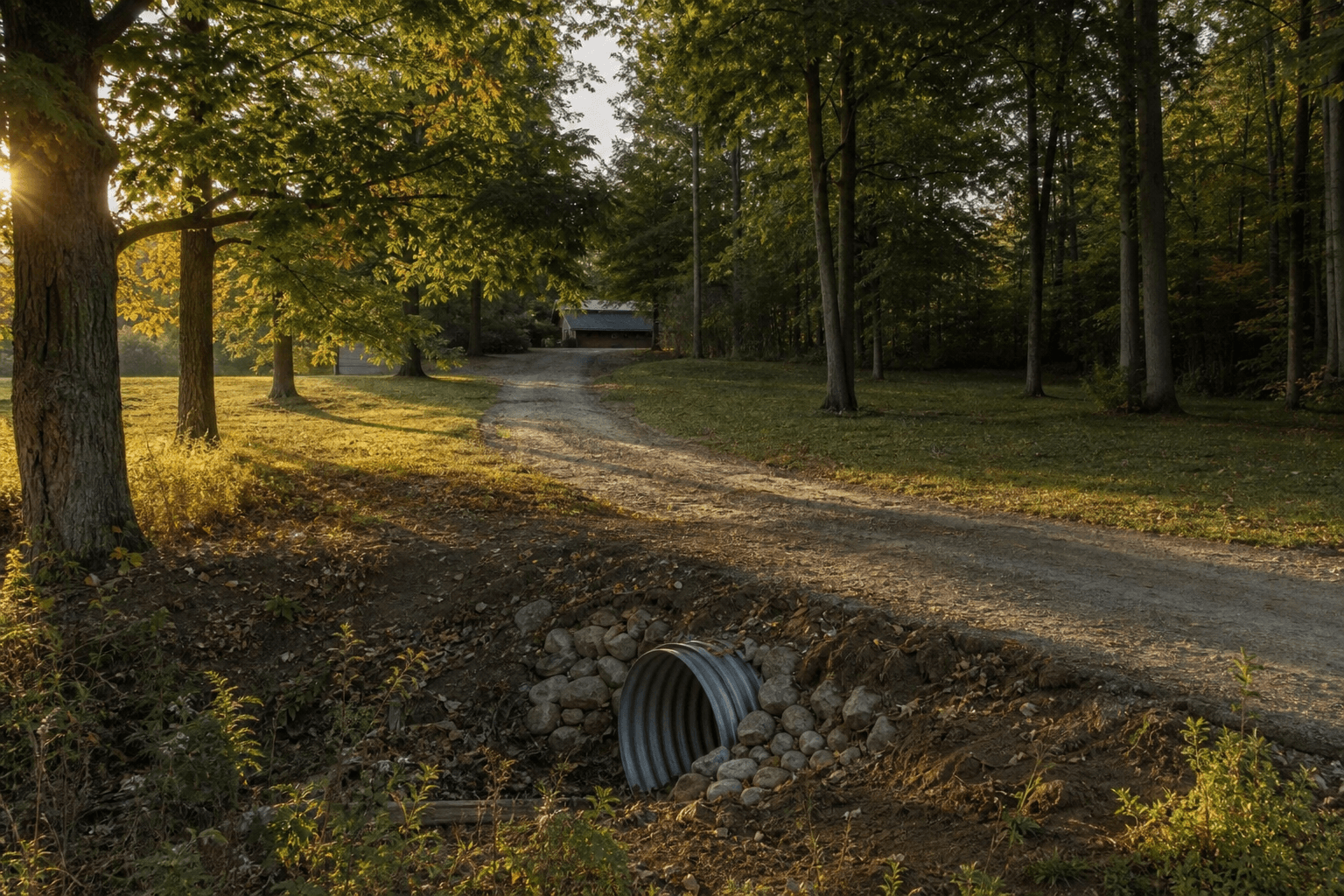
Before you call a supplier and guess at how many yards of fill to order, read the ground first — on paper. A topographic map gives you the elevation data to calculate exactly how much material a culvert crossing or drainage overpass requires. The math is not complicated. The inputs are all there on the map if you know how to read it.
This article walks through the process from map to material order: reading contour lines, calculating fill volume for a raised crossing embankment, and converting that volume into tons of compacted dirt and sandstone.
Reading the Topographic Map
A topographic map shows elevation through contour lines — lines connecting every point at the same elevation. The key number to find first is the contour interval, printed in the map legend. Common intervals:
- 2-foot interval — standard for detailed local surveys, site plans, and subdivision plats
- 5-foot interval — common on USGS 1:24,000 scale topo maps (the free ones)
- 1-foot interval — LiDAR-derived maps, often available from county GIS portals
Every fifth line is an index contour — printed darker, usually labeled with an elevation in feet above sea level.
What to look for at your crossing site
Find the low point where water flows. On a topo map, that is where contour lines form a V shape pointing uphill — that V is your drainage channel. The crossing sits across that V.
Mark two points: one on each side of the crossing, at the elevation where your finished road or path surface will be. The difference between those points and the existing channel bottom is your fill height — how deep the embankment needs to be at its tallest point.
On a simple crossing:
- Channel bottom elevation — read from the lowest contour line at the crossing
- Finished grade elevation — your target road or path surface, high enough to clear the top of the culvert pipe plus cover
- Fill height at centerline = finished grade elevation − channel bottom elevation
Example: Channel bottom at 892 ft. Finished grade at 896 ft. Fill height = 4 feet at the center of the crossing.
Calculating Fill Volume
A culvert embankment is not a rectangular box — it tapers from a wider base to a narrower top because fill slopes back at an angle for stability. The standard fill slope for compacted earth is 2:1 (horizontal to vertical) — for every foot of height, the base widens 2 feet on each side.
Step 1: Calculate the base width
For a 4-foot-high embankment with a 10-foot-wide path on top:
- Top width = 10 ft (your path or drive width)
- Side slope addition = 2 × height × 2 (both sides) = 2 × 4 × 2 = 16 ft
- Base width = 10 + 16 = 26 feet
Step 2: Calculate the cross-sectional area
Use the trapezoidal area formula:
Area = ((Top Width + Base Width) ÷ 2) × Height
Area = ((10 + 26) ÷ 2) × 4 = 18 × 4 = 72 square feet
Step 3: Multiply by length of the crossing
If the crossing is 30 feet long (bank to bank):
Volume = Area × Length = 72 × 30 = 2,160 cubic feet
Step 4: Convert to cubic yards
Cubic yards = cubic feet ÷ 27 = 2,160 ÷ 27 = 80 cubic yards
That is the compacted volume needed in place. To account for compaction during installation, multiply by 1.25 (loose fill compacts roughly 20–25%):
Loose fill to order = 80 × 1.25 = 100 cubic yards
Calculating Tonnage of Compacted Fill Dirt
Suppliers sell dirt and aggregate by the ton, not by the cubic yard, for delivery — so you need one more conversion.
Standard weight of compacted fill dirt (clay-loam mix, typical Ohio till):
~1.1 to 1.3 tons per cubic yard (use 1.2 as a working average)
For 100 yards of loose fill to order:
100 yards × 1.2 tons/yard = 120 tons of fill dirt
For tighter soils (heavy clay) use 1.3. For sandy or lighter loam, use 1.1.
Calculating Tonnage of Sandstone
Sandstone is used for two distinct purposes at a culvert crossing:
1. Rip-rap armoring — large angular stones placed at the inlet and outlet of the culvert to resist erosion from concentrated flow. Ohio DOT standards typically call for Class C or D rip-rap (6–18 inch stone).
2. Bedding and pipe surround — crushed sandstone or clean limestone aggregate placed under and around the culvert pipe for drainage and support.
Sandstone density
Sandstone (rip-rap, loose angular): ~1.35 tons per cubic yard Crushed sandstone or limestone aggregate (bedding): ~1.40 tons per cubic yard
Calculating rip-rap volume
A standard rip-rap apron at a culvert outlet is typically:
- Length = 3× the culvert pipe diameter (minimum)
- Width = 3× pipe diameter
- Depth = 1.5× pipe diameter or 12 inches minimum
Example: 18-inch (1.5 ft) diameter culvert pipe:
- Apron length = 4.5 ft
- Apron width = 4.5 ft
- Depth = 12 inches = 1 ft
- Volume = 4.5 × 4.5 × 1 = 20.25 cubic feet = 0.75 cubic yards
- Weight = 0.75 × 1.35 = ~1 ton of rip-rap per apron (inlet and outlet = 2 tons total)
Calculating pipe bedding volume
Bedding runs the full length of the culvert pipe, typically 6 inches below the pipe and 6 inches up the sides.
For an 18-inch pipe, 30 feet long, with a 6-inch bedding layer:
- Bedding cross-section ≈ 1.75 sq ft (U-shaped around the pipe bottom half)
- Volume = 1.75 × 30 = 52.5 cubic feet = ~2 cubic yards
- Weight = 2 × 1.40 = ~2.8 tons of crushed bedding stone
Summary: One Crossing, Full Material List
Using the example above (4 ft fill height, 10 ft wide path, 30 ft crossing, 18-inch culvert pipe):
| Material | Volume | Tons to Order |
|---|---|---|
| Loose fill dirt (20% overage) | 100 cubic yards | 120 tons |
| Rip-rap sandstone (both ends) | 1.5 cubic yards | ~2 tons |
| Crushed stone bedding | 2 cubic yards | ~3 tons |
| Total stone | 3.5 cubic yards | ~5 tons |
Add 10% to your stone orders as a field buffer — rip-rap placement is imprecise and stone is cheap insurance against running short.
Where the Topo Map Fits in Strongsville Permitting
Calculating fill volume from a topo map is not just for ordering material — it is often required documentation for a grading permit or stormwater review. Strongsville's engineering department and the Summit County Soil and Water Conservation District both review fill quantities and drainage alteration on projects that move more than a threshold volume of soil.
The same topo reading that tells you how many yards to order also tells the city engineer how much earth you are moving. Get the map right, and the calculation serves both purposes: procurement and permit.
For culvert sizing — the right pipe diameter to handle the design storm flow — that is a separate calculation based on drainage area, slope, and rainfall intensity, covered in the Foundation's work on the historic canal channel drainage permit and the potential dirt driveway and culvert at Maple Wesley Woods.
The fill math is the piece you can do from the map, at the table, before any equipment moves. Start there.