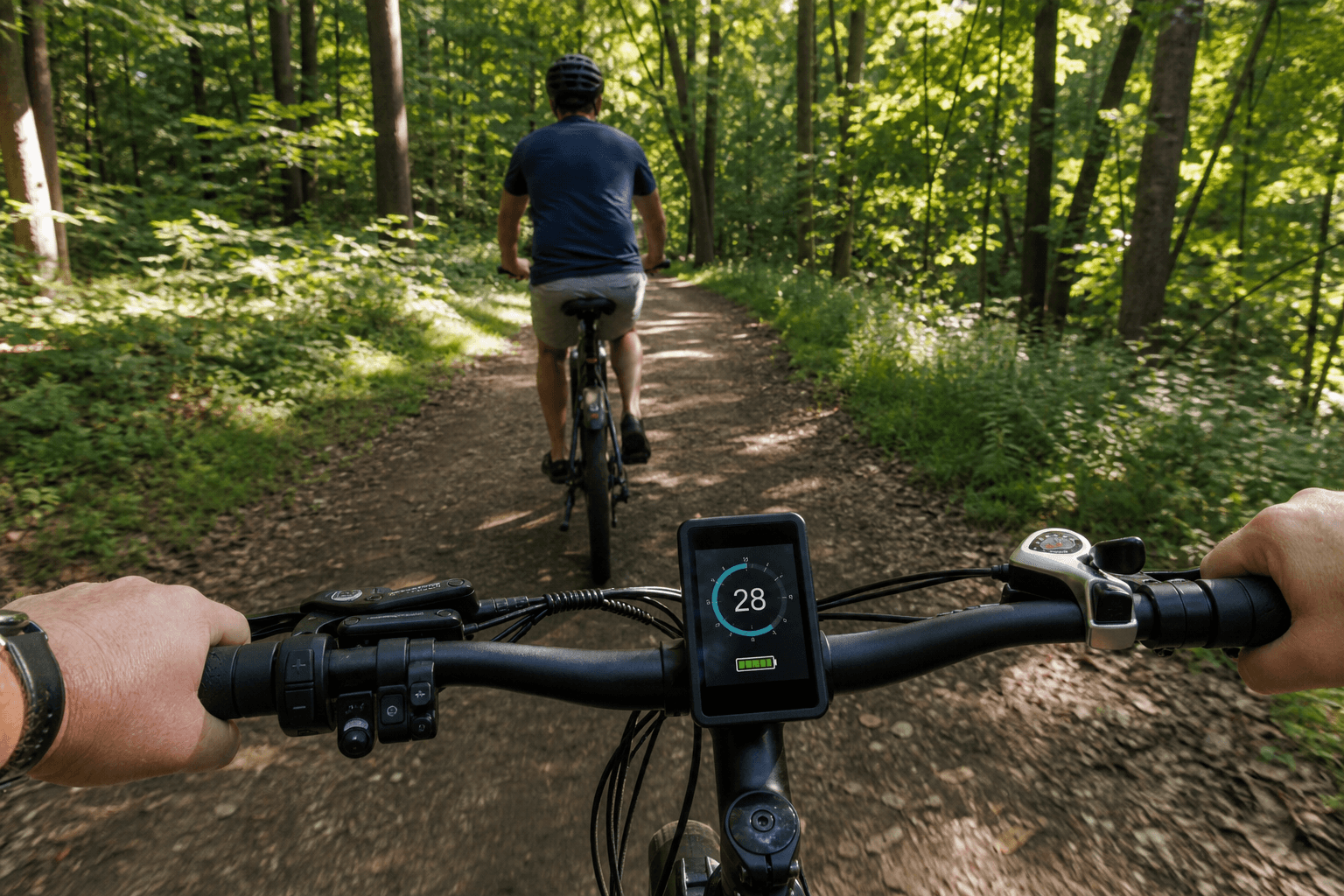
Class 3 is the fast lane of the e-bike world. Not because riders are reckless — because the machine is capable. Pedal-assist up to 28 mph, a speedometer on the bar, no throttle, and a set of laws that treat you differently than a regular bicycle the moment you leave quiet neighborhood streets.
The Wesley Stump Family Foundation is building e-bike safety education into Wesley Woods trail planning. This guide focuses on Class 3 specifically — how it is useful, how to ride it safely, and what Ohio law expects.
What makes a bike Class 3
Under Ohio House Bill 250 (codified in ORC § 4511.01), a Class 3 electric bicycle:
- Provides assist only while pedaling — no throttle
- Stops motor assist at 28 mph
- Requires a speedometer visible to the rider
- Requires the operator to be at least 16 years old
- Must carry a manufacturer label showing class, top assisted speed, and motor wattage
If your bike has a hand throttle or assists above 28 mph, it may not qualify as a Class 3 e-bike under Ohio law — and different rules may apply.
For the broader picture including sidewalk motor use and Class 1 and 2 differences, see our companion piece: Know Before You Ride: E-Bike Laws in Strongsville.
Utility — why people choose Class 3
There is a reason these bikes sell. They do real work:
- Hill climbing with less fatigue on long Ohio grades
- Commuting farther without arriving soaked in sweat
- Cargo and kid-hauling on routes that would feel slow on a traditional bike
- Keeping pace with traffic on some suburban arterials where slower bikes feel exposed
On private restoration land and approved corridors, Class 3 can make stewardship runs — tools, hoses, small equipment — faster and more realistic for a solo worker. That is utility, not sport.
The tradeoff is speed. Speed changes stopping distance, trail etiquette, and legal access.
Safety — Class 3 asks more of the rider
At 20 mph you can get away with sloppy habits. At 28 mph you cannot.
Helmet: Ohio does not mandate helmets for adult cyclists statewide, but Class 3 riders should treat a quality helmet as non-negotiable — especially on mixed surfaces.
Brakes: Inspect pads and rotors often. Heavier bikes at higher assist speeds need more stopping room.
Tires: Match tread and pressure to surface. A Class 3 on loose gravel or wet boardwalk is a different machine than on dry pavement.
Downhill control: Assist cuts at 28 mph, but gravity does not. Know your descent speed before you need the brakes.
Trail courtesy: Announce passes early. Slow for pedestrians, dogs, and children. A bell is cheap insurance.
Night riding: Ohio requires a white front light visible 500 feet and a red rear reflector or light (ORC § 4511.56). Class 3 without lights is a bad combination.
No headphones in both ears on public roads (ORC § 4511.84). You need full hearing at these speeds.
Impaired riding: OVI laws can apply to motorized bicycles on public ways. Treat a powered bike like a vehicle when the motor is doing the work.
The Foundation's planned e-bike safety trail corridor is designed for exactly this — practice speed, braking, and passing before you mix with cars and walkers.
The law — where Class 3 is allowed
Ohio's three-class system was meant to clarify access. In practice, Class 3 is the most restricted:
| Surface | Typical Class 3 access |
|---|---|
| Public roads | Generally allowed where bicycles are allowed |
| Shared-use paths / many rail-trails | Often restricted — check posted rules |
| Sidewalks | Motor on = motorized vehicle rules in many cities |
| Private property | Landowner rules apply |
Strongsville and surrounding communities often mirror state classification but add trail and sidewalk limits. Before you ride Class 3 on a new path, read the sign at the trailhead. If it says Class 1 only, believe it.
The sidewalk rule still catches people: if the motor is propelling you on a sidewalk, you may be treated as a motorized vehicle even where regular bikes are fine. Pedal unassisted or walk the bike.
Class 3 checklist before you roll
- Confirm the frame label says Class 3
- Speedometer working
- Helmet, lights if after dark, bell
- Know whether your route allows Class 3
- Motor off on sidewalks unless local law clearly permits otherwise
- Leave extra stopping distance — especially downhill
Class 3 e-bikes are not the problem. Speed without awareness is. Used with respect, they are one of the most practical tools on a hilly, spread-out landscape like Northeast Ohio.
Ride informed. Ride visible. Ride like the motor changes the rules — because it does.