Picture a man waking before sunrise in a canvas tent, in a forest that has no name on most maps yet. His back already aches from yesterday. His boots are still wet. Somewhere close by, a fire is going and coffee is on. This is the Ohio frontier in the 1820s, and he is about to spend twelve hours digging a canal with a shovel.
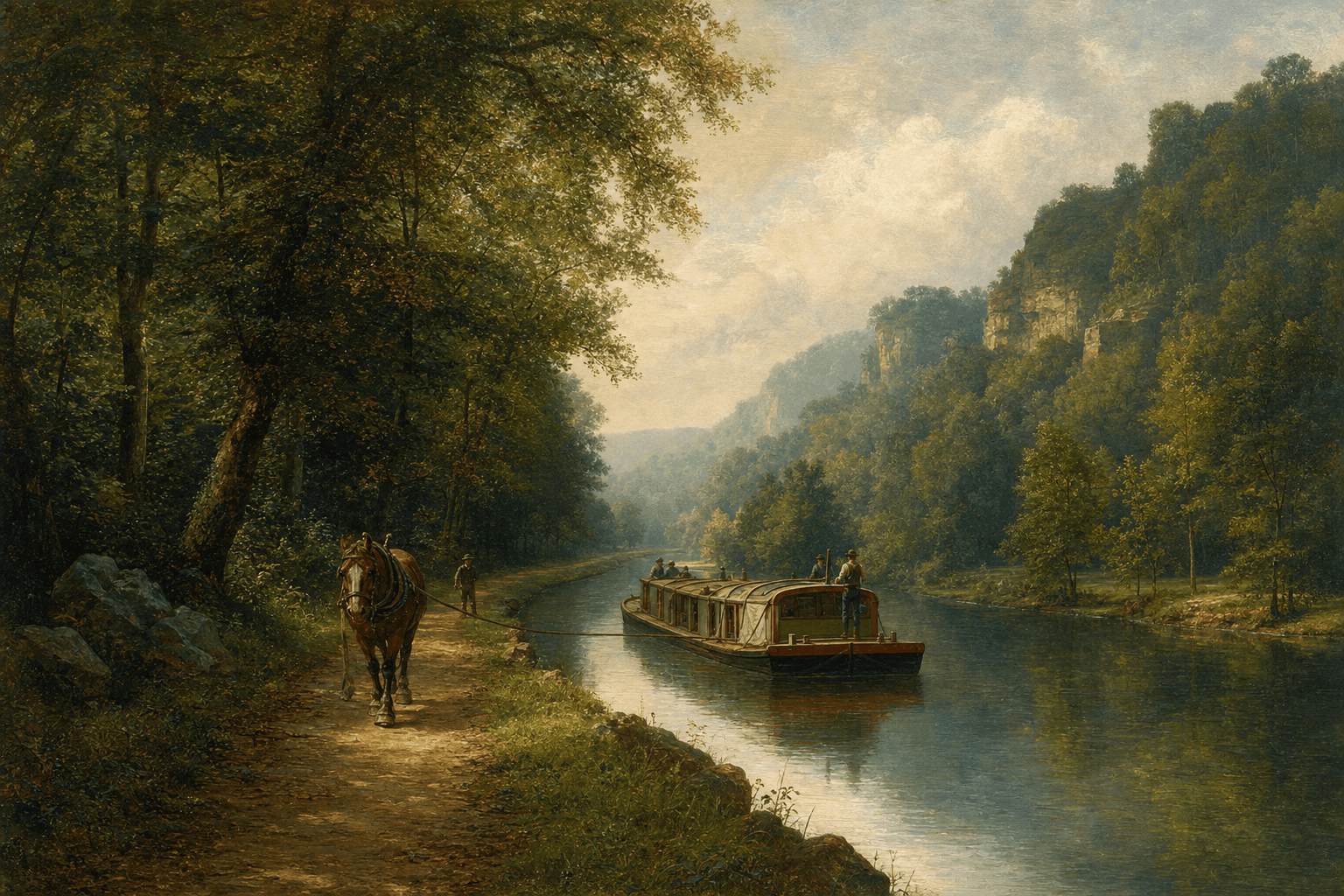
We think of the Ohio and Erie Canal as boats gliding on still water, a horse on the towpath, goods moving from Lake Erie to the Ohio River. But before any of that, there was the digging. Mile after mile of it, by hand, through forest and swamp and clay. This is a day in the life of the people who did it — and the support network that kept them alive long enough to finish.
Before Dawn: The Camp Wakes
The canal didn't follow towns. It cut through wilderness, so the workers lived where they worked — in temporary camps strung along the route. A camp was a cluster of tents and rough shanties, a cook fire, a supply wagon, and a stretch of half-dug ditch waiting for the day's labor.
The cook was up first. Usually it was women — wives, widows, hired hands — who ran the camp kitchens. Breakfast was heavy and plain: salt pork, bread, cornmeal mush, coffee strong enough to stand a spoon in. A digger burned through enormous calories, and the food had to match. A camp that fed its workers badly lost them fast.
Morning: Shovel, Pick, and Wheelbarrow
The tools were simple and brutal. A shovel. A pickaxe for clay and roots. A wheelbarrow to haul the spoil up out of the trench. The canal had to be dug to a set depth and width — four feet deep, forty feet wide at the surface on the main line — and the walls had to hold water. Every foot of it came out of the ground one shovelful at a time.
The worst enemy wasn't the dirt. It was the water and the disease that came with it. Much of the route ran through low, wet ground. Men dug in standing water. Mosquitoes were thick. "Canal fever" — malaria, mostly — moved through the camps and killed more workers than any cave-in or accident ever did. The frontier had no hospitals out here. The camp took care of its own or it didn't get taken care of at all.
The Animals Did the Heavy Pulling
A man could only carry so much. The real muscle came from animals. Teams of oxen, mules, and draft horses dragged scrapers and carts, pulled stumps, and hauled stone for the locks. A device called a slip scraper — a metal scoop dragged by a horse — could move earth far faster than a crew of men with shovels, and these became essential as the work scaled up.
The animals needed their own support: feed, water, harness repair, a farrier to keep them shod, a driver who knew how to read them. A lame mule was a real problem on the frontier. So was a sick horse. The camp's blacksmith mattered as much as any foreman.
Midday: The Network Behind the Shovel
This is the part that gets left out of the story. The canal was not built by diggers alone. It was built by a whole web of people most history books never name:
- Cooks and camp keepers who fed dozens of men three times a day from open fires
- Water carriers and supply drivers who kept the camps stocked with flour, salt pork, tools, and whiskey
- Blacksmiths and farriers who repaired tools and kept the animals working
- Stone masons and carpenters who built the locks, culverts, and aqueducts that made the ditch into a working waterway
- Families — wives and children who lived in the camps, kept the fires, mended clothes, and nursed the sick
- Local farmers who sold food and feed to the contractors, turning the canal into an economy before it was a canal
Many of the diggers themselves were immigrants — a large share were Irish, along with German and local frontier labor — paid low wages, often partly in whiskey, working under contractors who bid on sections of the route. They were tough, mobile, and largely anonymous. The canal was their monument, even if their names never made it onto it.
Afternoon: Building What Holds
Digging the channel was only half the job. Water doesn't stay where you want it without engineering. The skilled trades came in behind the diggers to build the things that made a canal a canal:
Locks raised and lowered boats between elevations — stone chambers with wooden gates, fit and sealed by masons and carpenters. Aqueducts carried the canal over rivers and ravines on timber and stone bridges. Culverts let natural streams pass underneath without flooding the channel. Towpaths were graded along the bank so the horses could pull the boats once water finally arrived.
Every one of these required grade, flow, and fit — the same problems anyone shaping water on the land still faces today. They solved them with hand tools, surveying chains, levels, and hard-won judgment.
Dusk: Back to the Fire
At the end of a twelve-hour day, the digger climbed out of the trench and walked back to the same fire he'd left in the dark. Supper, again heavy and plain. Wet boots by the fire. Talk, maybe a fiddle. Aches that wouldn't fully leave before morning.
The pay was a dollar a day, give or take, plus food and a place to sleep. It was dangerous, dirty, repetitive work in a wild place far from home. And mile by mile, season by season, it built the waterway that opened up Ohio.
Why We Tell This Story
The canal era reshaped Northeast Ohio's valleys and forests — the same landscape the Foundation stewards today. When we look at a narrow channel of water cutting through wooded ground, we're looking at the descendant of an idea that thousands of anonymous hands made real, two centuries ago.
This piece is part of the Foundation's Learn program: history told through soil, slope, water, and the systems people built to move through this region. The canal builders are gone. The valleys they dug through are still here. And the lesson holds — moving water through the land has always taken more than one person with a shovel. It takes a network. It always did.