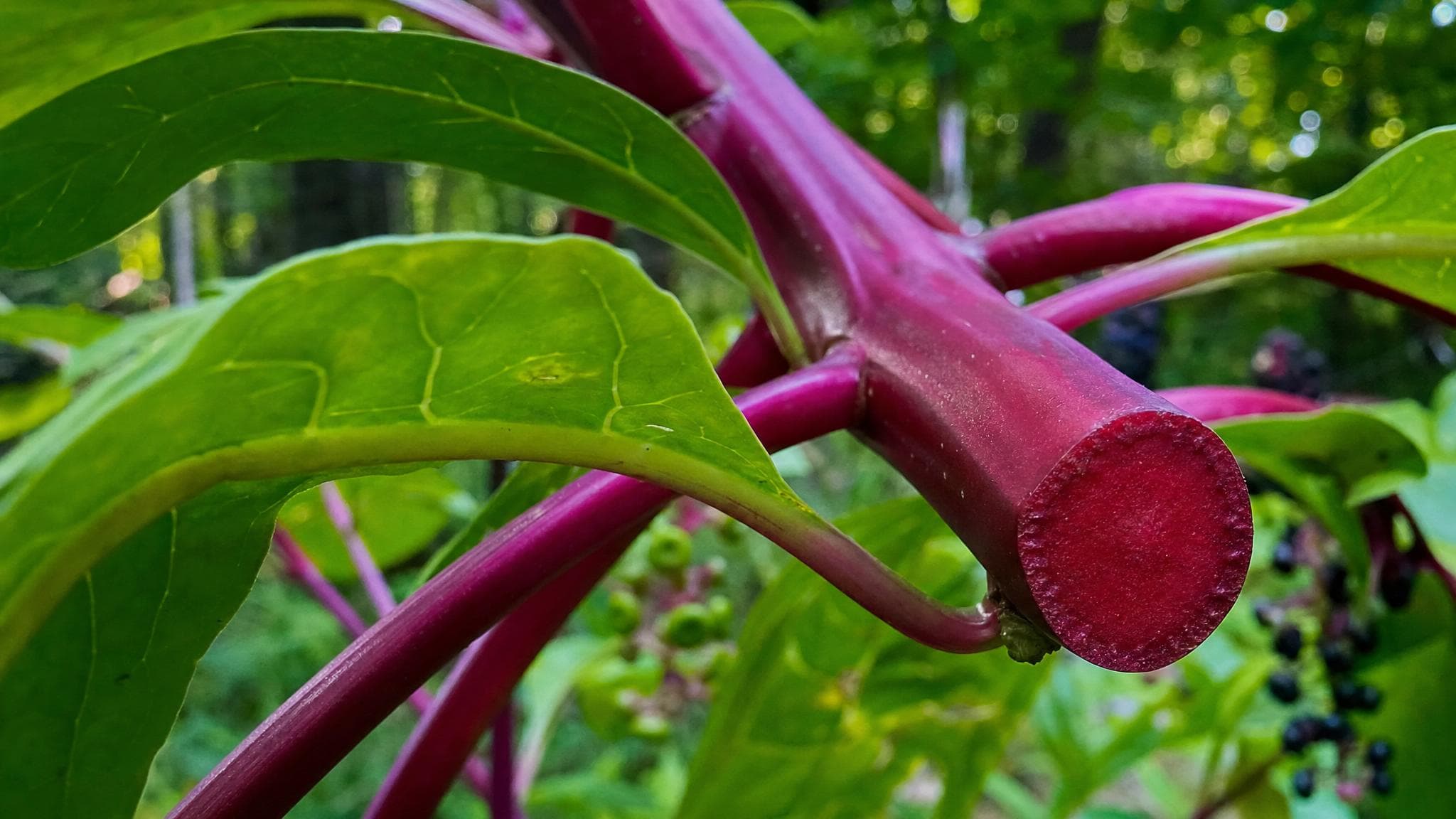
If you've been walking the trails at Wesley Woods and noticed a bold, leafy plant shooting up with bright green foliage and unmistakably red or reddish-purple stems, you're not imagining things — and you're right to stop and look twice.
That plant is almost certainly pokeweed (Phytolacca americana), one of the most visually striking — and most misunderstood — plants in the Ohio woodland landscape. It grows fast, it grows tall, and it wears its colors openly. Learning to identify it isn't just an interesting nature fact. On a working restoration property like the Foundation site in Strongsville, it's a genuine safety matter.
What Does It Look Like?
Pokeweed is hard to miss once you know what you're looking for. The plant emerges in spring as a compact rosette but grows aggressively through summer, often reaching six to ten feet in height by August. The key identifiers are consistent:
- Stems: Thick, smooth, and distinctly red to magenta-purple. Young plants may show lighter pink or reddish blush; mature stems are deep, saturated red-purple all the way through.
- Leaves: Large, smooth, and bright green — oval-shaped with a pointed tip and a slightly wavy edge. They can grow over a foot long on mature plants.
- Flowers and berries: In mid-to-late summer, pokeweed produces elongated clusters of small white flowers that mature into deep purple-black berries by fall. The berry clusters hang like dark grapes and are extremely attractive to birds — which is part of why pokeweed spreads so readily.
- Roots: Enormous, fleshy, and carrot-like. Often larger than the above-ground plant suggests.
Why It Matters
Every part of pokeweed is toxic to humans — roots most of all, but stems, leaves, and berries as well. The plant contains phytolaccatoxin and related compounds that cause severe gastrointestinal distress, vomiting, and in significant exposures, more serious systemic effects. Children and pets are especially vulnerable because the dark berries look edible.
Importantly, pokeweed toxins can be absorbed through broken skin. Volunteers handling pokeweed — especially when pulling or cutting mature stems — should wear gloves and avoid touching their face.
Other Red-Stemmed Plants to Know
Pokeweed is the most common red-stemmed plant you'll encounter at Wesley Woods, but it's not the only one worth recognizing:
- Red Osier Dogwood (Cornus sericea): Bright red twigs, opposite leaves, white berry clusters. This one is actually desirable — a native shrub that supports pollinators and wildlife. The red stems are vivid in winter when most plants are bare.
- Elderberry (Sambucus canadensis): Can show reddish tints on new growth. Compound leaves with serrated leaflets. Berries edible when cooked — raw berries cause illness. Common near wet areas on the property.
- Japanese Knotweed: Hollow, bamboo-like stems with reddish nodes; large heart-shaped leaves. An aggressive invasive — if you see it, flag it for removal.
What to Do
Pokeweed is a native plant and plays a genuine role in the ecosystem — birds rely on the berries, and it provides cover in disturbed areas. The Foundation does not remove all pokeweed from the property, but manages it away from high-traffic areas and trail edges.
If you encounter a red-stemmed plant and aren't sure what it is: don't pull it bare-handed. Photograph it, note the location, and ask a restoration team member. The Foundation maintains identification reference cards for all major species found at Wesley Woods for use by stewardship crews.
"Red stems are nature's way of asking you to pay attention," said a Foundation volunteer naturalist. "On this property, that instinct will serve you well."
When in doubt: look, learn, and leave it alone until you know what you're looking at.