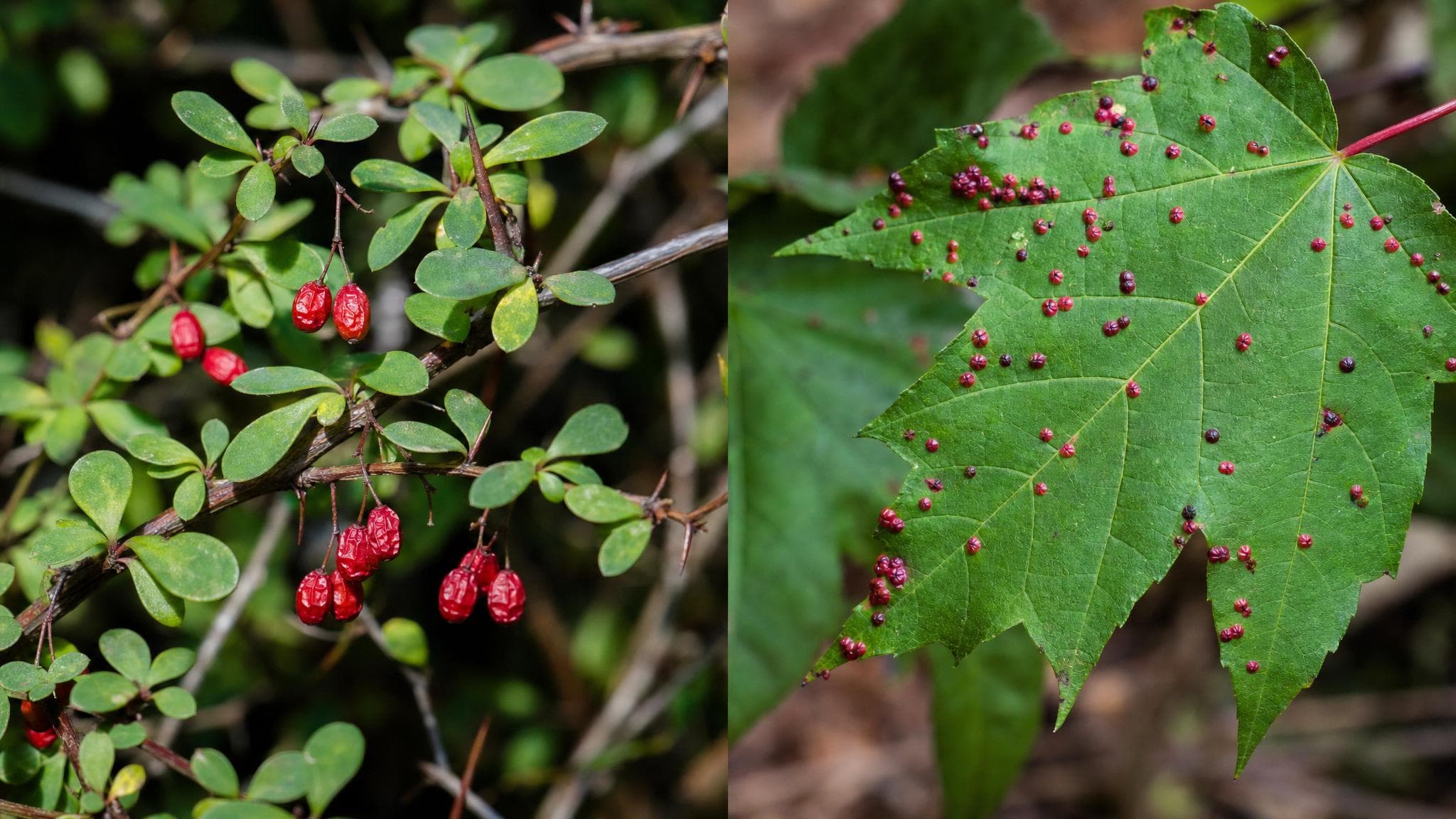
Two plant puzzles have been generating questions among the restoration team working at Wesley Woods this season — and both have clear, interesting answers worth knowing.
Mystery #1: The Small Thorny Shrub with Deflated Red Berries
What you saw: A low-growing shrub with very small, bright green oval leaves, sharp single thorns jutting from the stems, and small red berry-like structures that appear shriveled, deflated, or sac-like — almost like a tiny red balloon that lost its air. Nearby, you may have noticed larger branches with thorns from a different, larger plant.
What it is: Almost certainly Japanese Barberry (Berberis thunbergii), an invasive ornamental shrub that has escaped cultivation and established aggressively in Ohio woodlands and disturbed edges.
Japanese barberry is immediately recognizable once you know the pattern: small oval leaves (bright green in shade, sometimes reddish-purple in full sun), single sharp spines at each node, and small elliptical red berries that ripen in fall and persist through winter. Those "deflated" red sacs are old berries — they start plump and glossy, then wrinkle and collapse as they dry, taking on exactly the appearance you described.
The larger thorny branches nearby are likely Multiflora Rose (Rosa multiflora), another invasive species common in the same woodland edge habitat. Multiflora rose has curved thorns, compound leaves with small toothed leaflets, and produces tiny red rose hips in fall that also persist through winter.
Why it matters: Both Japanese barberry and multiflora rose are invasive species in Ohio and active targets for removal at the Foundation property. Japanese barberry is particularly problematic — research has linked its leaf litter to soil chemistry changes that favor other invasives, and it creates dense tick habitat due to the humidity its canopy traps near the ground. The Foundation's restoration team flags and removes barberry wherever it's found on site.
If you spot either plant, note the location and let a restoration team member know.
Mystery #2: Red Spots on the Maple Leaves
What you saw: Green Sugar Maple leaves with clusters of small, raised, vivid red spots or blisters — some as bright as a stop sign, scattered across the leaf surface in irregular patterns.
What it is: Maple Bladder Gall — caused by a microscopic mite, Eriophyes quadripes, that feeds on maple leaf tissue in early spring as the leaves are still developing. Each tiny red blister is an individual gall: a pocket of swollen plant tissue that forms around the mite as the leaf grows, essentially sealing the mite inside.
The galls start out pale green and nearly invisible, then turn vivid red or crimson as the season progresses, eventually darkening to near-black by late summer. On heavily affected trees, a single leaf can have dozens of galls, giving it a deeply spotted or blistered appearance.
Should you be concerned? For the trees themselves, not particularly. Maple bladder gall is primarily cosmetic — the mites cause visual damage but do not significantly harm mature, otherwise healthy trees. A tree already stressed by other factors (drought, vine damage, root competition) may be somewhat more affected, but bladder gall alone is not a tree health crisis.
For the Foundation's Sugar Maple restoration effort, the most important thing is ensuring the trees are healthy and vigorous enough to tolerate the mites naturally — which is precisely what the ongoing vine removal and trail management work supports.
The Bigger Picture
Both of these sightings point to the same thing: the more time you spend on this property with your eyes open, the more the land reveals itself. Japanese barberry hiding in the understory. Mites writing red calligraphy on maple leaves. A woodland is never just a backdrop — it's a conversation, if you know how to read it.
The Foundation's volunteer naturalist team is always happy to help with on-site identification. Bring your questions, your photos, and your curiosity. The land will keep providing the material.