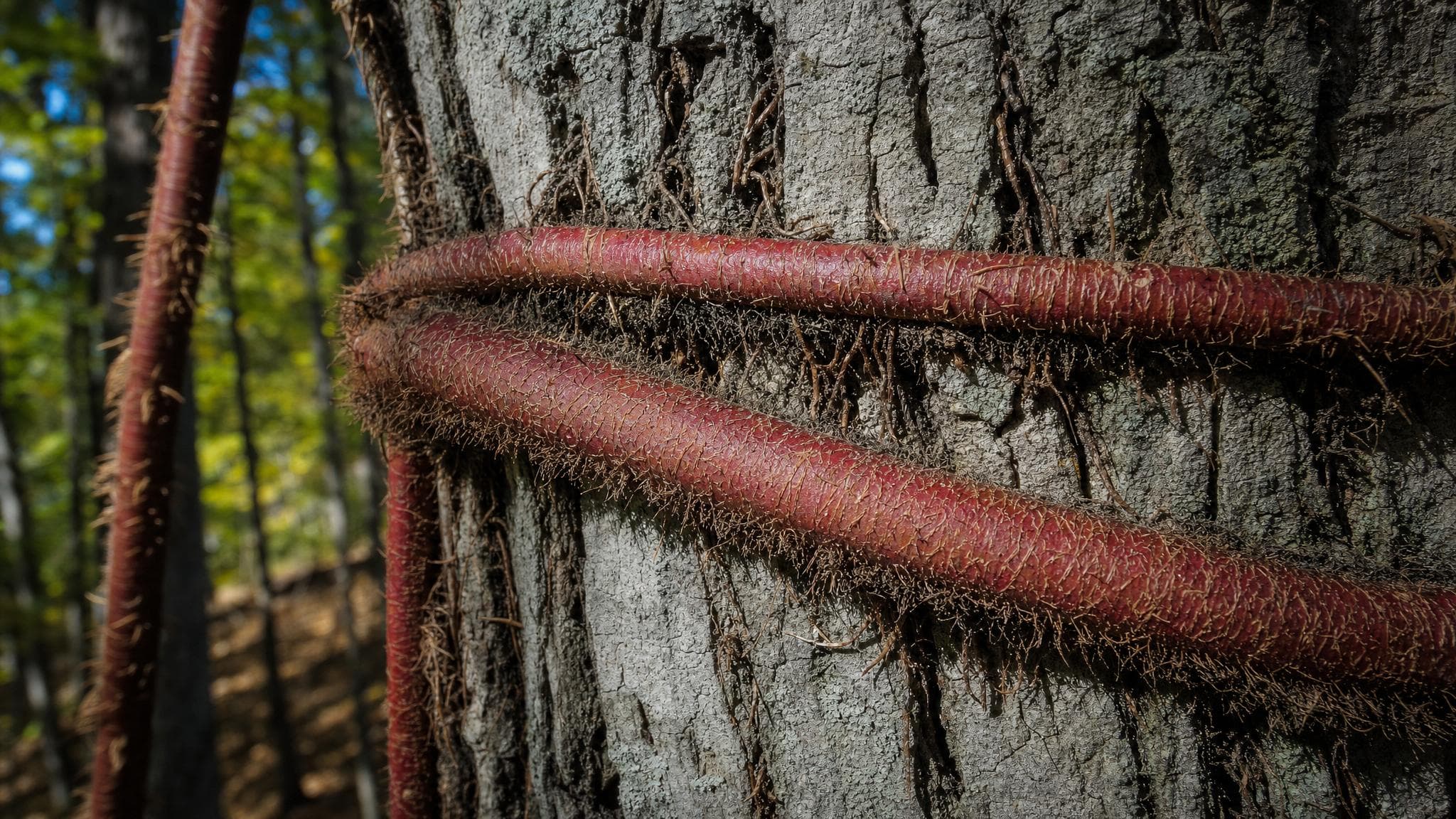
Some of the most damaging plants on a wooded property are the ones that look like they belong there. Thick-stemmed vines climbing toward the canopy, low thorny shrubs spreading across the forest floor, brushy tangles filling gaps between trees — left unchecked, these are not just cosmetic problems. They are slow, methodical takeovers that starve native trees, block regeneration, and eventually restructure an entire woodland.
At Wesley Woods in Strongsville, invasive species removal is one of the Foundation's highest-priority active stewardship tasks. This is private land under active management. Here is what we are dealing with — and how we are addressing it.
What We Are Removing and Why
Climbing Poison Ivy (Toxicodendron radicans)
Dense climbing poison ivy is one of the most structurally damaging vines on the property. Where it has been growing unchecked for years, it reaches rope thickness and spirals up mature Sugar Maple trunks well into the canopy. The physical constriction interferes with bark and nutrient transport. The vine mass in the upper crown competes directly for light. Contact with the urushiol compound causes severe dermatitis — presenting a direct hazard to anyone performing stewardship work on the property.
Removal protocol: Cut at the base, allow the vine to die in place before removing from the trunk to avoid disturbing the oils. Treat root crown with approved cut-stump herbicide to prevent regrowth. Work in full-coverage protective clothing.
Japanese Barberry (Berberis thunbergii)
Japanese barberry is one of the most invasive shrubs in Northeast Ohio. It spreads aggressively from both seed and root sprout, forms impenetrable low thickets with dense sharp thorns on every branch, and alters soil chemistry in ways that suppress native plant regeneration. It also serves as a reservoir host for blacklegged ticks, increasing tick pressure across the property.
Removal protocol: Full root extraction using a weed wrench or compact excavator for established plants. For dense thickets, cut-stump treatment followed by root removal the following season. Bag removed material — do not compost barberry.
Multiflora Rose (Rosa multiflora)
Multiflora rose is a federally listed invasive species in Ohio. It forms arching, thorny canes up to 15 feet long and spreads readily by bird-dispersed seed. A mature plant can produce hundreds of thousands of seeds per year. It shades out native seedlings, creates physical barriers, and provides no ecological benefit to native wildlife.
Removal protocol: Cut at the base before flowering to prevent seed set. Follow up with cut-stump treatment. Large established plants require full root removal to prevent resprouting.
Oriental Bittersweet (Celastrus orbiculatus)
Oriental bittersweet is among the most destructive woody vines in Ohio woodland systems. It grows rapidly, girdles trees by wrapping tightly around trunks and stems, and can pull down entire canopies under its weight. All fruiting material must be bagged and removed from the property — seeds remain viable after the plant is cut.
Removal protocol: Cut at base and remove all vine from the trunk. Treat root crown to prevent resprouting. Bag all fruiting material before removal.
Garlic Mustard (Alliaria petiolata)
Garlic mustard spreads rapidly in disturbed woodland areas and releases compounds into the soil that suppress mycorrhizal fungi — the underground networks that tree roots depend on for nutrient uptake. Dense infestations measurably degrade tree health over time.
Removal protocol: Hand-pull before seed set in spring, taking the full root. Bag and dispose of all flowering or seeding plants. Do not compost. Follow-up for multiple seasons is essential.
How We Work
All invasive removal at Wesley Woods is done manually or with minimal equipment. The Foundation uses pruning shears, loppers, hand saws, a weed wrench, and where appropriate, a compact excavator for established root systems. Chemical treatment is used narrowly — cut-stump applications only, targeted to specific root crowns — to minimize impact on surrounding native vegetation and soil biology.
Work is seasonal. Most removal happens in late fall through early spring when vines are dormant and easier to see, and when the risk of disturbing nesting wildlife is lowest.
What We Leave — For Now
Not everything comes out at once. Some invasive and overgrown understory still provides useful shade on open slope sections while the next wave of maple saplings grows toward the canopy. We remove what actively threatens mature trees and root systems. We wait on cover the forest still needs until native maples can take over that job.
What Comes After
Invasive removal is not landscaping — it is restoration work. Every barberry pulled and every bittersweet vine cut is making space for something better: the native understory that belongs here. Sugar maple seedlings, wild ginger, trillium, native ferns, and the dozens of other plants that form the ground layer of a healthy Northeast Ohio woodland all need that space to establish.
The Foundation is actively replanting cleared areas with native species appropriate to each zone of the property. The process is slow. Invasive species do not give up ground easily. But each season of sustained effort moves the property closer to what it should be: a stable, self-sustaining native woodland on a privately stewarded parcel in Strongsville.